

The solo founder's stack: the tools we use to run a software studio of one
The complete stack a solo founder needs to build, automate, and grow a portfolio of software alone — Build, Automate, AI, Observe, Distribute. The tools, the data behind them, and where to start.
TL;DR — Running a software studio alone isn't about working harder; it's about assembling a stack that does the work a team used to. We break ours into five layers — Build, Automate, AI, Observe, Distribute — and this is what sits in each, why, and where to start if you're building solo.
People assume a one-person software company is a story about hustle. It isn't. It's a story about tooling. The reason York Studio can run a portfolio of products with a team of one is that each layer of the work — building, gluing systems together, drafting, monitoring, and distributing — now has a tool or a workflow standing in for what used to be a hire.
This is the pillar that ties the rest of our writing together. If you only read one thing about building software solo, make it this: the stack is the strategy. Pick the right five layers and the rest is execution.
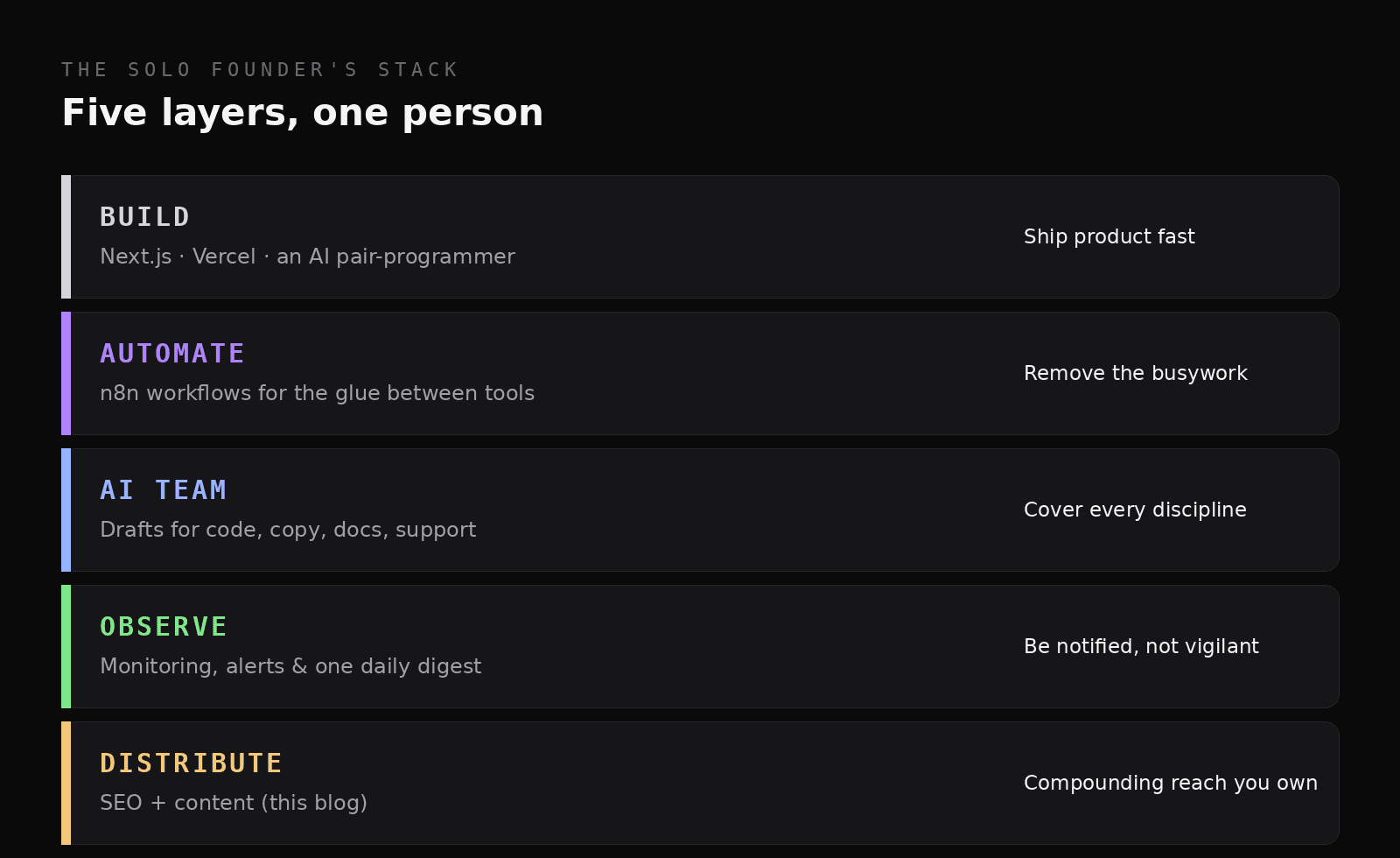
The solo founder's stack: five layers, one person.
Why the stack is the strategy
A team is, at bottom, a way of covering surface area. One person can't be a great engineer, designer, marketer, support rep, data analyst and ops manager at once — so companies hire specialists for each. The modern stack collapses that surface area. Every layer below replaces, or dramatically shrinks, a role that used to require a person. Your job as the founder shifts from doing each function to orchestrating the tools that do them.
That's not a fringe idea anymore. In Stack Overflow's 2024 Developer Survey, 76% of developers were using or planning to use AI tools, with active use jumping to 62% from 44% the year before. The shift to a tool-augmented way of working has already happened; the solo founder just leans on it harder than anyone.
Layer 1 — Build
What's in it: Next.js on Vercel, and an AI pair-programmer (we use one in the editor day to day).
The goal of the build layer is to get from idea to deployed product with as little friction as possible. A modern framework plus a zero-config host means deploys are a single "git push"; you're not running servers, you're shipping. (This very site runs on exactly that stack.)
The AI pair-programmer is the multiplier. In GitHub's controlled study, developers with an AI assistant completed a task 55% faster than those without. For a solo founder, that speed compounds: it's the difference between shipping one product a year and shipping a portfolio. The AI handles boilerplate, tests and unfamiliar APIs; you make the architectural calls.
Layer 2 — Automate the glue
What's in it: n8n (or similar) for the workflows between your tools.
Most of running a business isn't building product — it's moving information between systems. A new sign-up needs an account provisioned, a CRM record created, an onboarding email started, a billing entry made. Done by hand, that's a part-time job. Done as an automated workflow, it's invisible.
This is also where low-/no-code has gone mainstream: Gartner has predicted that around 70% of new applications will use low-code or no-code technologies, up from less than 25% a few years prior. The glue between your tools no longer needs a developer for every change — which is exactly what a team of one needs.
The catch: automations fail silently, and a broken one can do damage at scale. That's why this layer comes with a non-negotiable companion — observability — and why we built FlowVitals. (We go deep on this in monitoring n8n in production, and on what to automate in the first place in automate it or do it manually.)
Layer 3 — AI as the team you don't have
What's in it: AI assistants for first drafts of code, copy, documentation and support replies.
The research is clear that AI helps most where you're weakest — the rigorous Generative AI at Work study found a 14% average productivity lift, rising to 34% for the least experienced. A solo founder is, by definition, a novice at most functions. AI raises your floor across every discipline a team used to cover: it drafts the marketing email, the API docs, the SQL query, the support reply. You edit for taste and accuracy instead of starting from a blank page — and editing is faster and safer than creating. (We unpack this thesis in build like a team of one.)
Layer 4 — Observe everything
What's in it: monitoring and alerting for your product and automations, rolled into one daily digest.
You cannot watch ten dashboards. The observe layer's job is to make you notified, not vigilant — software watches the systems and interrupts you only when something is actually wrong, with enough context to act. That covers product uptime, but for a solo founder it especially covers the automations from Layer 2, where the expensive failures are the silent ones. The principle: don't ask "is the server up?", ask "did the work actually happen, correctly, recently?"
Layer 5 — Distribute
What's in it: SEO and content (this blog), plus owned channels like email.
This is the layer founders skip, and it's why good products die quietly. Building is now the easy part; being found is the hard part. The durable, compounding channel for a solo founder is content that ranks — writing that answers the questions your future customers are already searching, published consistently, and linked together so search engines see depth.
It applies to products too: for creators, the same "own your audience" logic is the entire pitch behind Clipora — turn rented attention into an audience you control (more in video funnels). Whatever you build, distribution is a layer of the stack, not an afterthought.
The shared foundation
Here's the part that makes it a studio and not just a single app. These five layers are built once and reused across every product. One design system, one deployment pipeline, one automation setup, one monitoring stack, one content engine. The second product inherits all of it, so it launches further ahead than the first. The third further still.
That shared foundation is the real leverage of the portfolio model: the marginal cost of the next bet keeps falling, which is how one person can credibly run two products as different as Clipora and FlowVitals at the same time.
What we deliberately keep manual
A stack this capable tempts you to automate everything. Don't. We keep humans firmly in the loop on pricing and positioning, anything touching trust, safety or legal exposure, the first conversation with an early customer, and the taste-level call about what to build next. Those are the parts where a human who cares is the product. The stack exists to clear everything else off your plate so you have the attention to do them well.
The takeaways
- A team covers surface area; a stack covers it for less. Orchestrate tools instead of doing every function yourself.
- Build: a modern framework + host + AI pair-programmer turns ideas into deploys fast.
- Automate: workflow tools handle the glue between systems — paired with monitoring, always.
- AI team: drafts across every discipline you're weak in, which is most of them when you're solo.
- Observe: be notified, not vigilant. Ask whether the work happened, not whether the server is up.
- Distribute: content and owned channels are a layer of the stack, not an afterthought.
- Build the five layers once, reuse them across products — that shared foundation is the whole studio model.
Building your own studio of one? Tell us what you're working on.
References
- Stack Overflow (2024). Developer Survey — AI.
- GitHub (2022). Research: quantifying GitHub Copilot's impact on developer productivity.
- Gartner (2021). Forecast: Worldwide Low-Code Development Technologies.
- Brynjolfsson, E., Li, D., & Raymond, L. (2023). Generative AI at Work. NBER Working Paper 31161.