

Video funnels: how creators turn views into an audience they own
Views are rented attention. A video funnel converts that attention into emails, sales and bookings you actually own. Here's how video-first funnels work — and why owning the audience beats renting reach.
TL;DR — A viral video is rented attention; the platform owns the relationship. A video funnel converts that attention into something you own — an email, a sale, a booking — while you have it. Here's how it works, and why we built Clipora around it.
Every creator eventually learns the same hard lesson: views are not an audience. A viral video is rented attention. The platform owns the relationship, the algorithm decides who sees you next, and a single ranking change can erase your reach overnight.
It's a strange position to be in, because the opportunity has never been bigger. Goldman Sachs estimates the creator economy could approach half a trillion dollars by 2027, up from roughly $250B, with the global population of ~50M creators growing 10–20% a year. More money, more creators, more competition — and most of it still built on rented land.
The way out is to convert attention into something you own — an email list, customers, bookings — while you have it. That's what a video funnel does.
Decoration vs. engine
On most platforms, video is decoration: it plays, it ends, and the viewer scrolls on. In a video funnel, the video is the engine. It actively drives the viewer toward a next step instead of leaving them at a dead end.
That shift — from passive view to guided journey — is the whole idea. And it works because video is already the most persuasive format we have. In Wyzowl's State of Video Marketing 2024, 86% of marketers said video increased conversions, adding video to a landing page can lift conversions by up to 80%, and 82% of people said they'd been convinced to buy something by watching a video. The attention converts — if you give it somewhere to go.
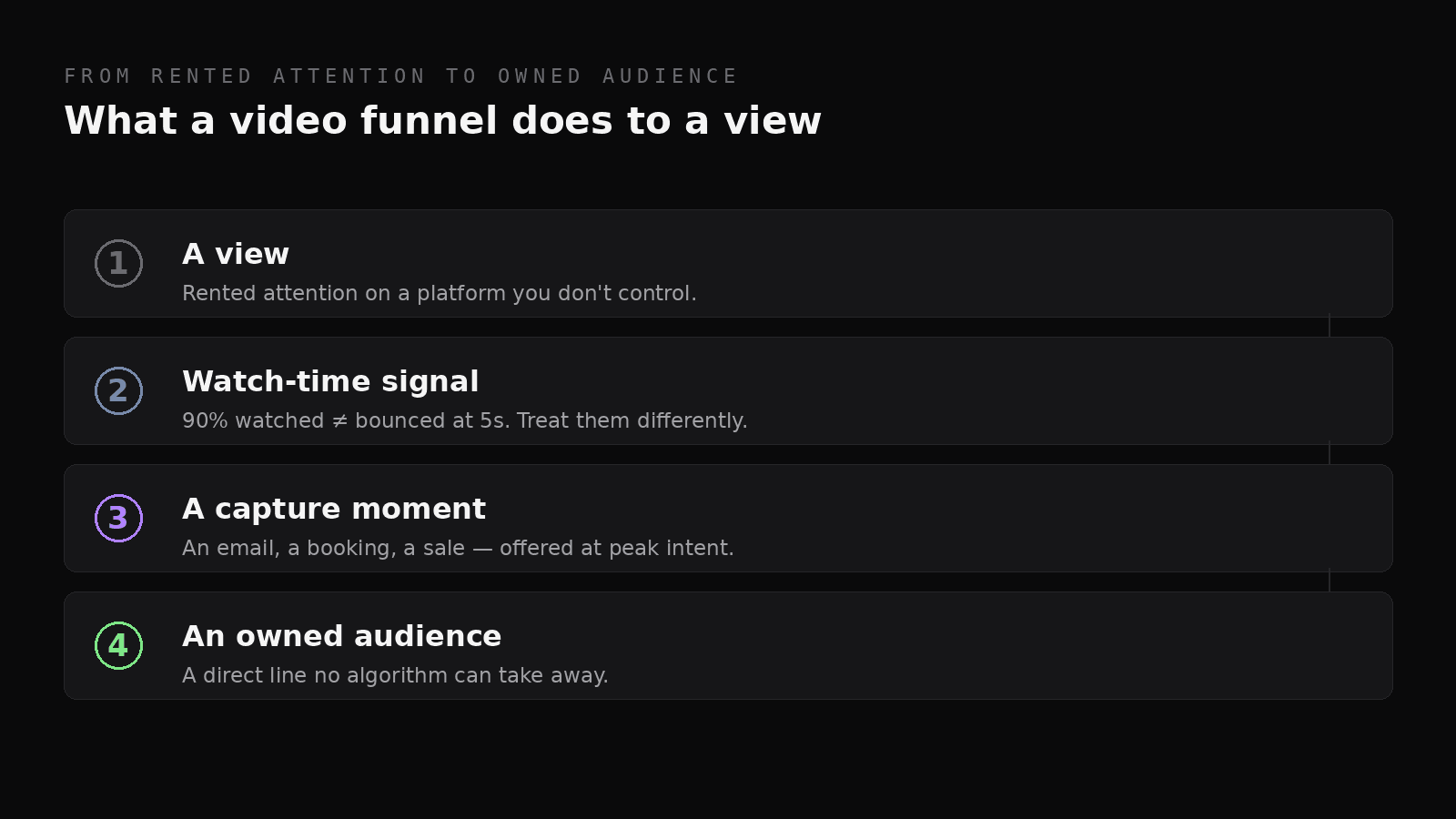
A video funnel turns a passive view into an owned relationship, stage by stage.
What a video funnel actually contains
A good video funnel wraps the video in a lightweight conversion experience:
- Capture moments. Email or contact forms that appear at the right time — after the viewer has gotten value, not before.
- Calls to action. Buttons and links timed to the moment of peak intent, rather than buried in a description nobody reads.
- Branching paths. Let the viewer choose where to go next, and send different viewers down different routes based on what they engage with.
- Watch-time triggers. Someone who watched 90% of your video is a very different lead from someone who bounced at five seconds. Treat them differently.
Own the relationship
The single most important output of a funnel is a direct line to the viewer that no platform can take away. An email address is worth far more than a follow, because you can reach it whenever you want, on your terms — no algorithm in between.
The economics back this up. Email marketing returns an estimated $36–$42 for every $1 spent, the highest ROI of any digital channel. A follower is a number on someone else's platform; an email subscriber is an asset on yours. This is the difference between building on rented land and building on land you own.
Why the platforms make this hard
None of this is an accident. Platforms are designed to keep the relationship — and the attention — on the platform. Reach is rationed by an algorithm you don't control and can't appeal, link-outs are often demoted because they send people away, and the rules change without notice. Creators have watched a format get throttled overnight, or an account restricted with no human to ask. Building your entire business on someone else's distribution means accepting that your most valuable asset can be devalued by a decision you'll never see coming. A funnel is how you hedge that risk: you still play the platform game for reach, but you convert a slice of every wave of attention into something portable.
The metrics that matter
Once video is a funnel instead of decoration, the numbers you watch change. Views and likes become top-of-funnel vanity metrics; the ones that matter sit lower down:
- Watch-through rate — how far people get is the clearest signal of intent.
- Capture rate — the share of viewers who give you an email or contact. This is the number a funnel exists to move.
- Earnings per view (EPV) — revenue divided by views tells you what attention is actually worth, and whether a piece of content is a business or a hobby.
- List growth and health — the size and engagement of the audience you own, because a dead list is just a number.
Lower the effort, not the quality
The honest objection is that building funnels sounds like work. Historically it was — landing pages, form tools, automations, analytics, all stitched together. That friction is why most creators never bother, and why their best videos keep converting attention into nothing.
Removing that friction is exactly what Clipora is built for: a video-first funnel and conversion platform where AI-assisted funnel generation drafts the calls to action, sequencing and paths for you, so the video itself drives where a viewer goes next. You bring the video; the funnel comes together in minutes. (It's one half of the York Studio portfolio — the same build-it-once-remove-the-busywork thinking behind FlowVitals.)
What this looks like in practice
Say you're a creator who teaches productivity. You post a two-minute video on a tactic that's getting traction. In a funnel, that video doesn't just end: at the 70% mark — once a viewer has actually learned something — a card offers a free template in exchange for an email. Viewers who take it enter a short sequence that delivers the template, then a few more of your best tactics, then an invitation to a paid course. Viewers who don't still saw a clear call to action at the moment of peak interest. The same video that would have earned a like now earns a subscriber, and a fraction of those subscribers become customers — on a list you own and can reach again next week without paying for reach.
Where to start without rebuilding everything
You don't need to overhaul your whole channel to begin. The lowest-risk way in:
- Pick your one best-performing video — the one that already earns attention you're currently wasting.
- Add a single capture moment — one clear, valuable offer (a template, a checklist, early access) in exchange for an email, placed after the viewer has gotten value.
- Wire it to one email sequence — three or four messages that deliver the offer and introduce what you do.
- Measure capture rate and iterate — move that one number before you scale the pattern across everything.
One video, one offer, one sequence. Prove the loop on a small surface, then repeat it. That's how an occasional viral hit turns into a compounding audience instead of a spike on someone else's chart.
The takeaway
If you make video, you're already generating the hardest part of a funnel: attention. The opportunity is to stop letting that attention evaporate. Convert a fraction of every view into an audience you own, and you build something the algorithm can't take back.
The takeaways
- Views are rented attention; the platform owns the relationship, not you.
- Treat video as the engine of a funnel, not decoration — give every view somewhere to go.
- Capture at the moment of value, act on watch-time signals, and branch by intent.
- An email subscriber is an owned asset; a follower is a number on rented land.
- The winning move is lowering the effort of building funnels, not the quality of your video.
Building an audience as a creator? Tell us what you're working on.
References
- Goldman Sachs (2023). The creator economy could approach half-a-trillion dollars by 2027.
- Wyzowl (2024). The State of Video Marketing 2024.
- Litmus. The ROI of Email Marketing.