

Pricing your first SaaS: the mistakes solo founders make
Underpricing is twice as common as overpricing and far harder to fix. Here's the arithmetic that decides whether your business works, the five mistakes to avoid, and how to test a price properly.

TL;DR — Underpricing is roughly twice as common as overpricing, and much harder to undo. The cause is psychological, not analytical: naming a low number avoids rejection. But price sets the shape of your business — at $10/month you need a thousand customers, at $99 you need a hundred — and one of those is survivable solo.
Most founders agonise over their product for months and pick a price in an afternoon. Usually by looking at a competitor, going slightly under, and rounding to something that ends in 9.
That afternoon decides more about whether the business works than most of the months did.
The arithmetic that decides everything
Start here, because it makes the rest of the argument concrete. Say your goal is $10K MRR — the number we dug into in how long it takes to get there.
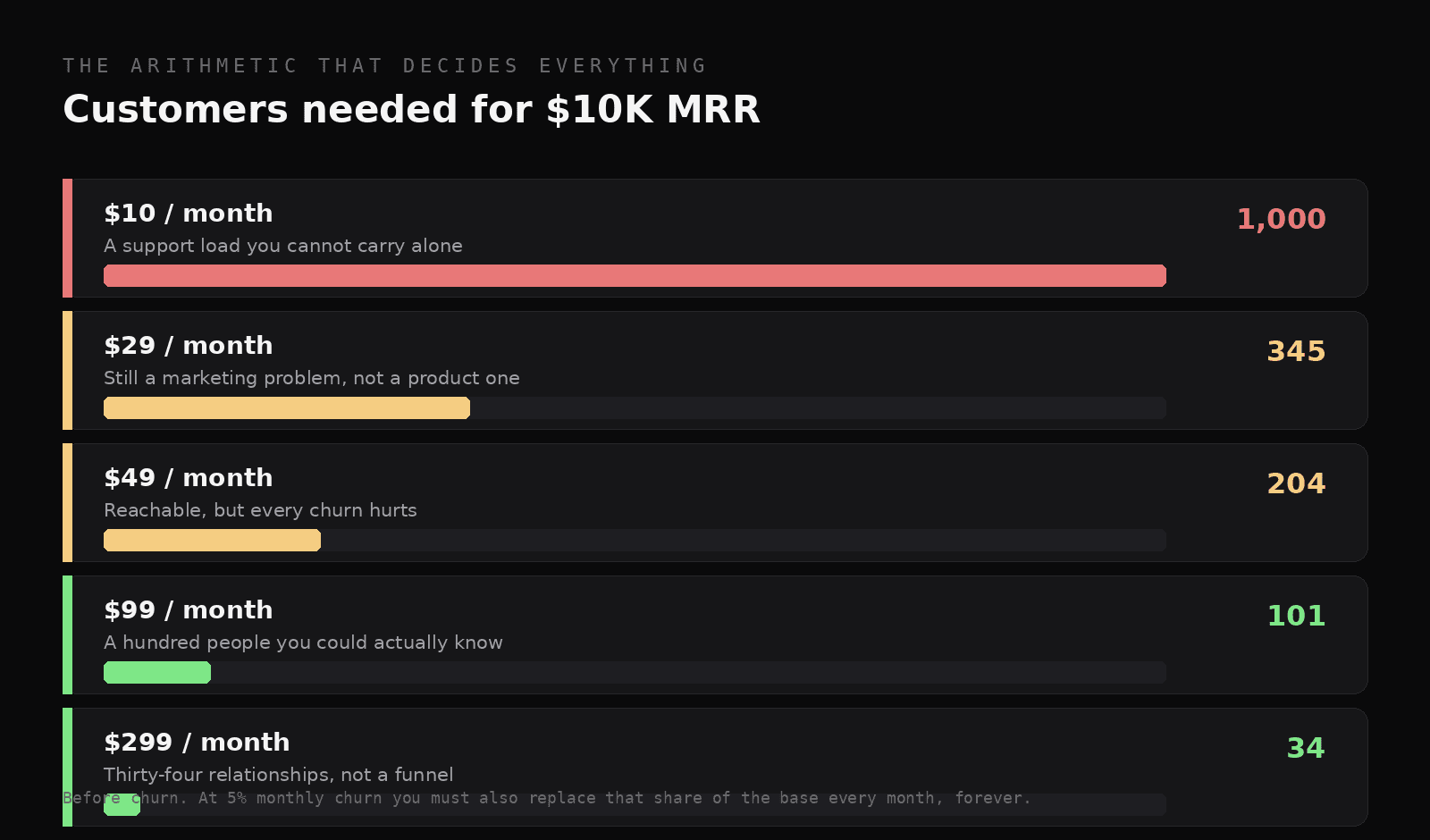
The same revenue goal, five completely different businesses.
At $10/month you need 1,000 paying customers. As a solo founder, that's a support inbox you cannot personally carry, a marketing machine you can't staff, and — because paid products churn 5–10% monthly — fifty to a hundred replacements to find every single month, forever.
At $99/month you need 101 customers. That's a hundred people you could plausibly know by name. At $299, thirty-four relationships rather than a funnel.
Same revenue. Wildly different lives. The low-price version isn't just harder — for one person it's often structurally impossible, and no amount of hustle fixes an arithmetic problem. This is why we said in the $10K MRR post that pricing is one of the three things that decides which side of the outcome distribution you land on.
Why founders underprice
Underpricing is about twice as common as overpricing and considerably harder to correct, and the reason isn't spreadsheets. It's that naming a high number invites rejection, and naming a low one feels safe.
The specific self-deceptions, in roughly the order we've heard them:
"I'll compete on price." Being cheapest is the one position a solo founder can't defend — anyone can undercut you, and you have the least margin to absorb it. It also selects for the customers who churn hardest and complain most, which is the worst possible retention starting point.
"It's only a small tool." Customers don't buy your line count; they buy an outcome. A "small" tool that saves someone six hours a month is worth vastly more than $9 to them, and pricing it at $9 tells them it isn't.
"I'll raise prices later." You can — but it's the hardest change to make, requires migration comms and grandfathering decisions, and every month you wait adds more customers who anchored on the old number. Raising is possible; starting right is cheaper.
"I'll price off my costs." Your hosting bill is not a pricing input. It's a floor, and a very low one.
The honest reframe: a price is a hypothesis about value, and the only way to learn is to test it against real buyers. Which brings us to the part most founders skip.
Test the price before you build
The single most predictive validation step, as we argued in validating a SaaS idea, is explicit willingness-to-pay testing — and you don't need a product to do it.
The simplest version is a direct ask in a customer conversation: "if something solved this properly, what would it be worth to you?", followed by naming a real number and watching what happens. Hesitation, enthusiasm and "that seems reasonable" are all data. A deposit is better data.
For something more structured, the Van Westendorp Price Sensitivity Meter asks four questions — at what price would this be too expensive, too cheap to trust, expensive but worth considering, and a bargain — and maps the answers into an acceptable range and an optimal point. It works with modest sample sizes in B2B, which suits a solo founder who can't survey thousands.
One honest caveat worth knowing: field experiments have found that Van Westendorp systematically overestimates willingness to pay compared with methods where money actually changes hands. Treat it as a way to find the plausible range, then confirm the number with a real transaction. Stated preference remains cheaper to give than money.
Five mistakes worth avoiding
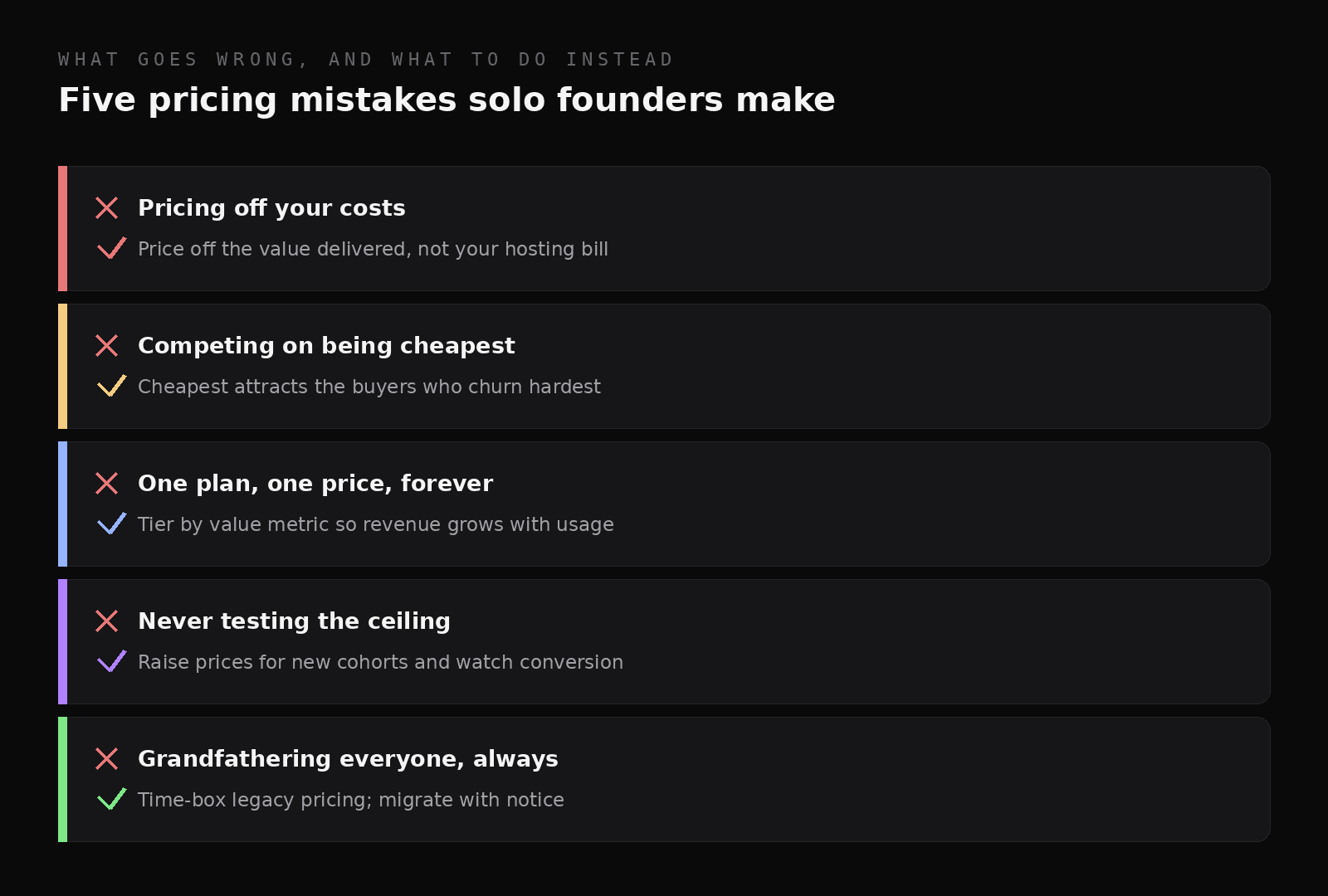
What goes wrong, and what to do instead.
1. Pricing off your costs. Price off the value delivered. If your tool saves an agency ten hours a month, the relevant anchor is what ten hours costs them — not what your VPS costs you (a trap we walked through in self-hosted vs cloud n8n).
2. Competing on being cheapest. Compete on being specific. A tool that's obviously built for one type of buyer can charge more than a general one, because it needs less explaining and fits better.
3. One plan, one price, forever. Pick a value metric — the thing that grows as customers get more value (seats, workflows, monitored instances, members) — and tier on it. Then revenue grows with a customer's success instead of requiring you to find another customer.
4. Never testing the ceiling. You can raise prices for new customers only, and watch conversion and churn. If conversion holds, you were leaving money on the table. Most founders never run this experiment even once — and price increases done with clear communication frequently hold while materially improving margins.
5. Grandfathering everyone forever. Legacy pricing is kind, and unbounded legacy pricing is a slow tax on your future. Time-box it, migrate with real notice, and accept that a small number of people will leave. That's the cost of a business that still works in three years.
What we'd actually do
For a new product in the York Studio portfolio, the pricing process looks like this:
- Work backwards from the arithmetic. Decide how many customers you can realistically serve and support alone, divide your revenue goal by it, and let that set the floor. If the answer is "I need 800 customers," the price is wrong, not the goal.
- Ask ten buyers what the outcome is worth, before building. Name numbers. Watch faces.
- Launch higher than feels comfortable. The discomfort is the signal you're near the real ceiling rather than under it.
- Pick a value metric on day one, even with a single plan — retrofitting one later means re-pricing every existing customer.
- Test a rise every six months on new cohorts only. It's cheap, reversible, and the only way you'll find the ceiling.
- Treat retention as the other half of pricing. A higher price with good retention compounds; a higher price with bad retention just churns faster and more expensively.
The honest summary
Pricing is the highest-leverage number in a solo software business and the one founders spend the least time on. It sets how many customers you need, which customers you attract, how much support load you carry, and whether the whole thing is survivable by one person.
The most common mistake is not a bad framework — it's the quiet decision to avoid rejection by naming a small number. Charge for the outcome you deliver, test it with real buyers before you build, and revisit it on a schedule rather than never.
The takeaways
- Underpricing is ~2× more common than overpricing and much harder to correct.
- Do the arithmetic first: $10K MRR is 1,000 customers at $10/month, or 101 at $99. Only one is survivable solo.
- Price off delivered value, not your costs — and compete on specificity, not on being cheapest.
- Test willingness to pay before building; use Van Westendorp for the range, a real transaction for the number.
- Pick a value metric on day one, and test a price rise on new cohorts every six months.
Working out what to charge? Tell us about your product — it's a good problem to think out loud about.
References
- Monetizely. Five things you should never do in a SaaS pricing strategy — underpricing frequency.
- Monetizely. Pricing model research: Van Westendorp & conjoint analysis.
- Development Corporate. How to run a Gabor-Granger or Van Westendorp pricing test — overestimation caveat.
- Fatgraphs. Most SaaS companies underprice themselves.