

Retention is the growth channel most founders ignore
Most founders obsess over acquisition. But for subscriptions, communities and creator businesses, growth compounds when more people stay. Here's why retention is a growth channel — and how we made it operational with Retain.

TL;DR — Acquisition is visible and glamorous; retention is quiet and usually more profitable. For subscription, membership and creator businesses, growth compounds when more people stay — yet most founders under-invest in it. This is how we think about retention as a growth channel, and how we made it operational with Retain, our churn-save app that's now live on Whop.
Most software companies talk about growth as if it only means getting more people in the door. More traffic, more signups, more leads, more followers, more customers. That work matters — but for subscription businesses, communities, memberships and creator products, acquisition is only half the equation. The other half is quieter, less glamorous, and usually more profitable: do people stay?
That question is why we built Retain. It's a retention and revenue-recovery app for Whop community owners — it recovers failed payments, saves cancellations and wins back churned members automatically, then shows the owner the real revenue it kept. Not by spamming users, not by hiding the cancel button, not by pretending "AI messages" are a strategy — but by making retention operational. Because retention isn't one metric. It's the system that decides whether growth compounds or leaks away.
Acquisition gets attention. Retention creates enterprise value.
Acquisition is visible. You can launch a campaign, run ads, sponsor newsletters, appear on podcasts and watch the top of the funnel move. Retention is less obvious — it happens after the sale, after the excitement fades — which makes it easy to ignore.
But ignoring it creates a dangerous illusion. A company can look like it's "growing" on the surface while quietly replacing the same lost customers every month underneath. Revenue comes in, churn takes it out, and the founder ends up running faster just to stand still.
The economics are stark. Classic Bain & Company research by Fred Reichheld, published in Harvard Business Review, found that increasing customer retention by just 5% increases profits by 25% to 95%, and that acquiring a new customer can cost five to twenty-five times more than retaining an existing one. When customers leave quickly, every acquisition channel gets more expensive; when they stay, one-time acquisition turns into a compounding asset.
A retained subscriber doesn't just pay again. They give the business more time to deliver value, more chances to expand the relationship, more opportunities for referral, and more evidence about what the market actually wants. That's the part many founders miss: retention isn't just a defensive metric — it's a growth channel.
Retention is not one number
A common mistake is treating retention as a single figure. It works badly, because different businesses need to retain different things. A SaaS product wants accounts to keep using and paying. A creator wants an audience to keep paying attention, not just stay subscribed. A community wants members to keep participating and belonging. A membership wants subscribers to keep renewing — and to keep feeling it's worth paying for.
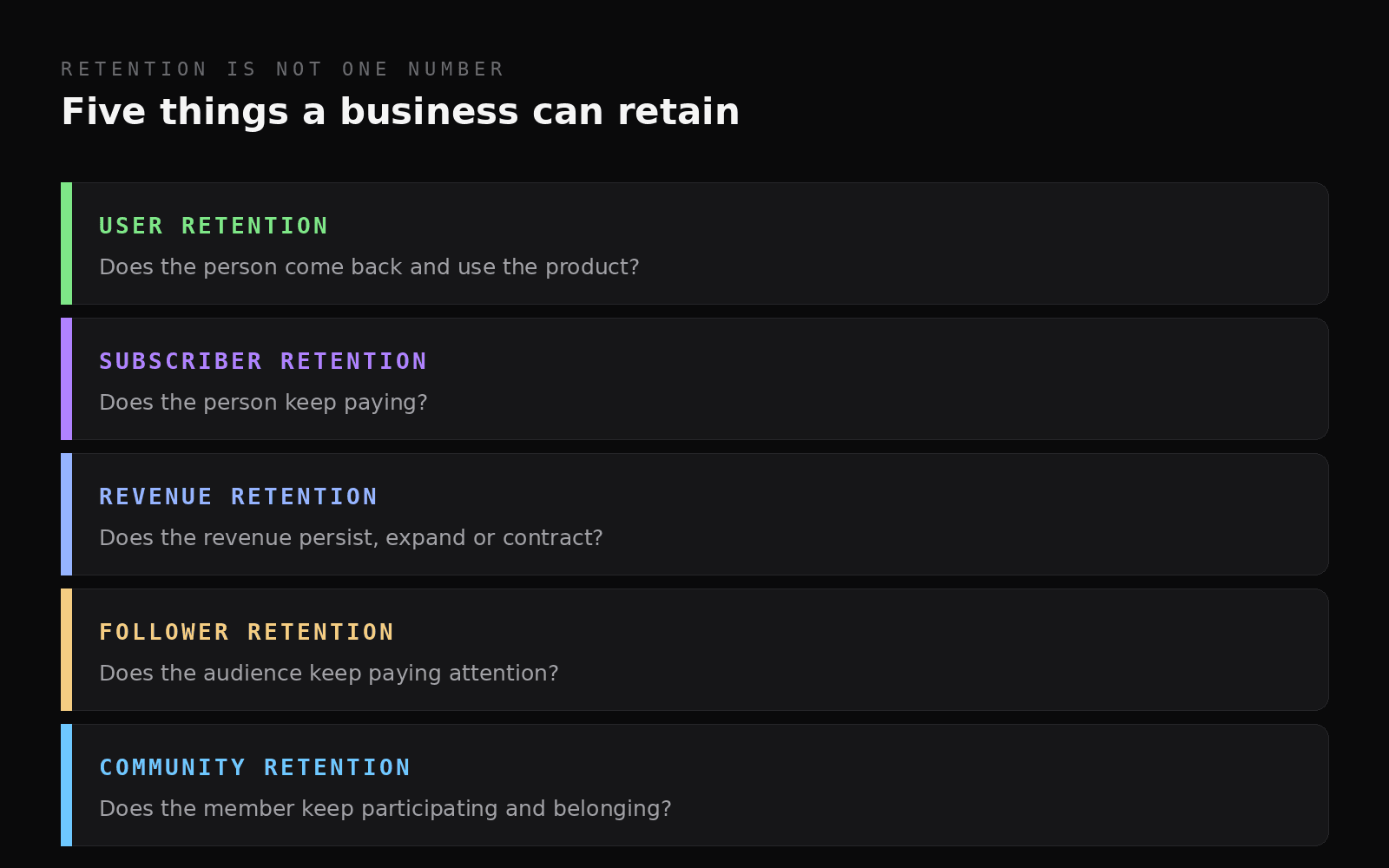
Retention isn't one metric — it's at least five different objects, each with its own question.
We separate retention into five categories: user (do they come back and use it?), subscriber (do they keep paying?), revenue (does the money persist, expand or contract?), follower (does the audience keep paying attention?), and community (does the member keep participating and belonging?). These overlap but aren't the same. A user can be active but not paying. A subscriber can keep paying while mentally checked out. A follower can stay subscribed while never opening anything. A community member can be "in the group" while no longer feeling connected to it.
That's why Retain is built around lifecycle events, not vanity metrics. The useful question is never "how many members do you have?" It's: where is value leaking, and what can we do about it at the right moment?
The practical retention equation
The simplest way to think about it:
Retention = recurring perceived value × habit/context fit × switching-cost advantage × trust − unresolved friction − irrelevant communication − better alternatives.
That sounds abstract but it's practical. People stay when they repeatedly experience value, at the right cadence, with low friction, inside a context where staying makes sense. They leave when the product stops feeling useful, becomes annoying, breaks trust, costs too much, fails to fit their life, or gets replaced by something better.
For subscription businesses, churn usually traces to a handful of causes: the customer never reached the first meaningful outcome; the value was real once but stopped being visible; the product was useful but not habit-forming; the price became hard to justify; a payment failed and nobody recovered it; support or trust broke down; the customer finished the job they came to do; or a better alternative appeared.
Each cause needs a different response — and this is where most retention automation goes wrong. It treats every customer the same and sends generic "we miss you" emails. But someone who never activated doesn't miss the product yet. Someone with a failed payment doesn't need a marketing email — they need a clean way to update their card. Retention gets better when the intervention matches the reason.
The lifecycle moments that matter
Retain is designed around the specific moments where businesses lose revenue unnecessarily.
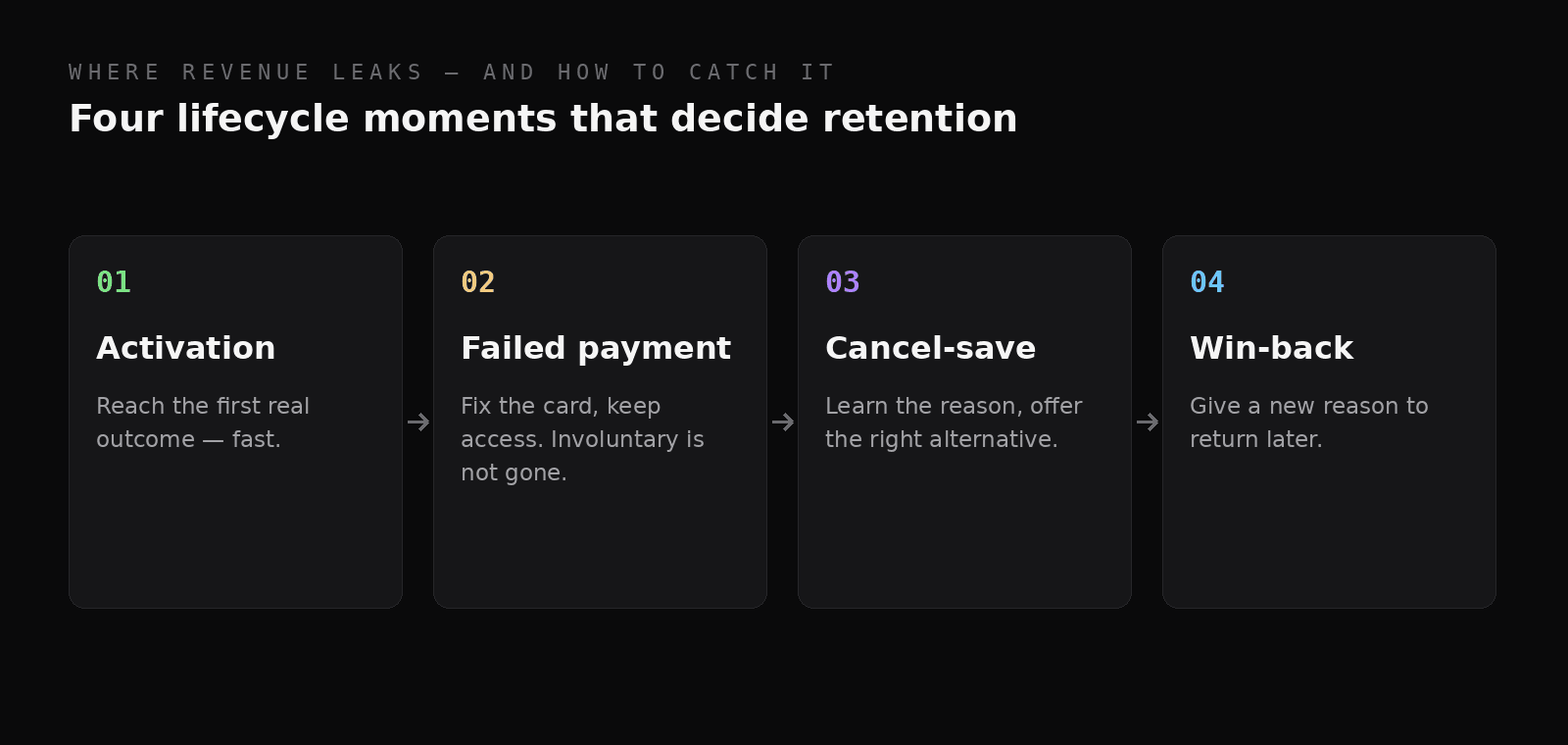
The four lifecycle moments where revenue leaks — and where the right intervention catches it.
1. New member activation
The first retention problem happens early: a customer signs up or pays but never reaches the first meaningful outcome. That's not churn yet — it's failed activation. For a SaaS product, activation might be the first integration or first useful alert; for a community, a first post or a useful reply; for a membership, watching the first lesson. If activation fails, the customer starts questioning the purchase almost immediately. The fix isn't "send more emails" — it's identifying the stalled step and helping the person reach value faster. Good activation messaging is specific ("You joined but haven't completed setup — start here"); bad activation messaging is vague ("Don't forget to check us out").
2. Failed-payment recovery
Failed payments are one of the most overlooked retention opportunities, because this is involuntary churn — an expired card, a bank issue, insufficient funds — not a decision to leave. And it's bigger than most founders think: Recurly's research puts involuntary churn at 20–40% of all subscription churn, the majority of which is recoverable with the right retry logic and dunning. These are willing customers disappearing by accident.
A good recovery flow is calm, direct and operational: "Heads up — your renewal didn't go through, so you may lose access soon. You can update your payment method here." No guilt, no panic — just a clear explanation, a direct link and sensible retries. Retain's view is that this should be automatic, measurable and respectful: detect the event, send the right message, stop the sequence the moment the payment recovers, and — crucially — count a save only when the nudge truly earned it, staying honest about the platform's own automatic retries.
3. Cancellation-save flows
A cancellation flow has two jobs, in order: learn why the customer wants to leave, then offer a relevant alternative to full churn. Too many products jump straight to a discount, which teaches customers that threatening to cancel gets a lower price. A better flow asks the reason first. Too expensive? A downgrade, pause or annual plan might help. Not using it? An onboarding reset or smaller commitment. Missing a feature? A workaround or roadmap note. Finished with the need? Let them leave cleanly and win them back later.
The point is that cancellation shouldn't be a black box. Every cancellation is a data point; every save attempt should be tied to a reason; every "saved" customer should be attributed conservatively — "12 members stayed after seeing a pause option," not "AI saved $10,000."
4. Win-back after churn
Not every customer can or should be saved at cancellation — some are wrong-fit, some are simply done. That's fine. But churn isn't always permanent. Win-back works when there's a genuinely new reason to return: a new feature, a better offer, a seasonal trigger, a solved objection, a changed circumstance. The weak version is "we miss you." The strong version is: "Since you left, we added the thing you asked for — here's the fastest way back." For memberships and creator businesses, timing is often the real issue: someone may not need the product this month but need it again later.
Why this matters for creators and communities
Creator-led businesses have a specific retention problem. They often have strong acquisition — through content, audience, personality — but weaker operational systems behind the scenes. People join because they trust the creator; they leave because ongoing value isn't made visible, the community doesn't pull them in, a payment fails, or the membership becomes easy to forget. That doesn't mean the product is bad. It means the lifecycle is unmanaged.
This is the same "own the relationship" thread that runs through the rest of what we build — it's why creators should convert attention into an audience they own with Clipora, and then keep that audience with the operational layer Retain provides. Software helps here not by replacing the creator, but by handling the operational layer around them: detecting lifecycle events, sending timely messages, tracking recovery, surfacing churn reasons, and showing where revenue is leaking.
Retain's wedge: revenue recovery, not generic engagement
The market doesn't need another tool that sends generic automated messages — founders already have email tools, community platforms and CRMs. Retain has to be sharper than that, so it leads with what a platform doesn't operationalise. On Whop, native chat already handles welcome and onboarding, so Retain leads with recovering failed payments, saving cancellations and winning back churned members. Proven sequences turn on in minutes, with quiet hours and per-member frequency caps so nobody gets spammed.
Crucially, Retain shows its work. Every save is recorded in a conservative, windowed attribution ledger — honest about the platform's own auto-retries — so owners see the real MRR they saved, the MRR still at risk, and a weekly saved-revenue report, rather than a vanity number. It installs from the Whop App Store and connects a community in under a minute, with a Starter tier for onboarding and failed-payment recovery and a Pro tier adding cancel-save, win-back and the full attribution dashboard. The promise isn't magic — it's operational clarity: open Retain and see where revenue is leaking, what the system is doing about it, and what needs a human.
Good retention is respectful
There's a line between retention and manipulation. Good retention helps customers get the value they already wanted. Bad retention traps people, hides cancellation, abuses notifications, or discounts aggressively to delay the inevitable. We're not interested in dark patterns. A good retention system makes cancellation possible, asks for feedback clearly, offers relevant alternatives, stops messaging when the issue is resolved, avoids guilt-based copy, respects frequency norms, measures conservatively, and treats customers like adults.
This isn't only an ethics point — it's a business one. Trust is part of retention. If you make it hard to leave, a customer might stay one more month, but the relationship is damaged, and they're less likely to return, refer or buy again. The best retention work increases value, reduces friction and preserves trust.
What founders should measure
Don't start with a complicated dashboard — start with clear definitions. Ask: who are we trying to retain, what action proves it, over what interval, from what starting point, and what kind of churn are we seeing? Then separate the metrics by model. For subscription revenue: subscriber churn, MRR churn, failed-payment and recovery rate, cancellation reasons, gross and net revenue retention. For product usage: activation rate, time to first value, repeat usage by cohort, inactivity before cancellation. For communities: first-post rate, active cohorts, repeat participation, contribution depth. For creator audiences: repeat opens and views, replies, saves, and paid conversion from older cohorts — retained attention, not just total followers.
The key is measuring the right retention object. A paid subscriber who never logs in looks "retained" in revenue data but is a future churn risk. A follower who stays subscribed but never sees the content isn't really retained attention. The metric has to match the business model.
The product lesson behind Retain
Retain isn't just an app idea — it reflects a broader York Studio belief: the next wave of useful AI software won't be generic assistants; it'll be focused systems that operate specific business workflows. Retention is a perfect example. The workflow is repetitive enough for software — detect event, classify risk, choose playbook, send message, stop when resolved, record outcome, report result — but sensitive enough that the system must be careful, because tone matters, attribution matters, and the wrong message can hurt the relationship. That's exactly where AI-native software should sit: not replacing judgement, but making the operating system sharper. (It's the same thesis behind the whole solo-founder stack and the portfolio model — build focused systems on a shared foundation.)
Where we go from here
We built Retain because retention is under-served for the long tail of subscription and membership businesses. Companies with large teams already build lifecycle systems internally — they have analysts, lifecycle marketers and engineers. Smaller operators don't. A creator selling a membership shouldn't have to build their own churn analytics, dunning flow, cancellation survey and win-back system from scratch. A community owner shouldn't have to guess why members leave. That's the opportunity.
If acquisition is how a business starts, retention is how it compounds. Retain is our bet that more small subscription businesses need that compounding layer — packaged into software simple enough to actually use. Because the best growth isn't always more people at the top of the funnel. Sometimes it's fewer good customers leaking out the bottom.
The takeaways
- Acquisition is visible and glamorous; retention is quiet and usually more profitable — a 5% retention lift can raise profits 25–95%.
- Retention isn't one number. Decide what you're retaining: users, subscribers, revenue, followers or community.
- Match the intervention to the reason — generic "we miss you" messages fail because they ignore why someone is leaving.
- Failed payments are 20–40% of churn and mostly recoverable; it's some of the highest-ROI retention work there is.
- Good retention increases value, reduces friction and preserves trust — dark patterns cost you the relationship.
Running a Whop community, or any subscription business? See Retain or get early access.
References & further reading
- Reichheld, F. / Bain & Company. The Value of Keeping the Right Customers, Harvard Business Review.
- Recurly. Churn Rate Guide (involuntary churn share and recovery).
- Reichheld, F. & Sasser, W.E. "Zero Defections: Quality Comes to Services," HBR.
- Andrew Chen, "Retention is King"; and Lenny Rachitsky on retention benchmarks.
- Amplitude, Mixpanel, Baremetrics and ChartMogul resources on retention, churn and subscription metrics.