

The portfolio model: how a solo studio runs many bets on one foundation
Betting everything on a single product is risky; building a studio of many products on one shared foundation isn't. Here's how the portfolio model works for a solo founder — and the data showing studios outperform.
TL;DR — Most founders pour everything into one product and live or die by it. A studio spreads several focused products across one shared foundation of design, infrastructure and brand — so each new bet is cheaper, faster and lower-risk than the last. Here's how the model works, the evidence behind it, and how we apply it at York Studio.
Ask most people how a one-person company should work and they'll describe a single founder, heads-down, betting everything on one product. It's the default mental model — and for a solo builder, it's unnecessarily fragile. If that one bet misses the market, there's nothing to fall back on.
The studio model flips this. Instead of one big bet, you run a small portfolio of focused products on top of a shared foundation. It sounds like more work for one person, not less. Done right, it's the opposite — because the expensive part is built once and reused.
The problem with betting everything on one product
Single-product founders carry a concentration risk that has nothing to do with how good they are. Markets shift, a platform changes its rules, a bigger competitor ships your feature, the timing is simply wrong. When 100% of your effort is tied to one outcome, any of those can end the company.
This isn't an argument for being unfocused — it's an argument against being fragile. A portfolio doesn't mean doing many things badly at once; it means that no single product's failure is fatal, and that the lessons (and the infrastructure) from one feed directly into the next.
What a studio does differently
A studio separates the product (the part that's different each time) from the foundation (the part that's the same every time). The foundation is the boring, expensive, reusable layer underneath every product.
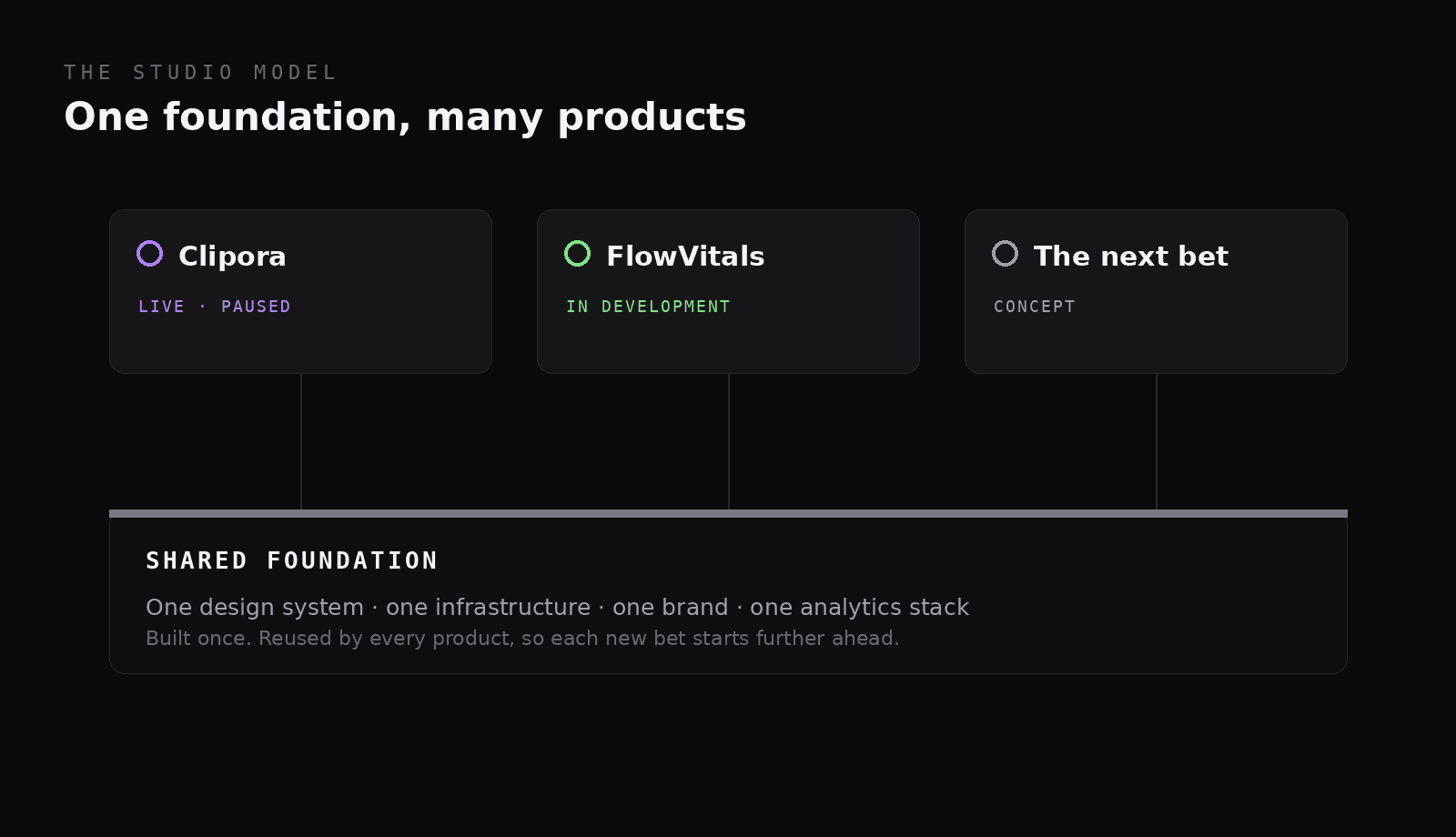
The studio model: products change; the foundation is built once and reused.
When a new idea arrives, you're not starting from zero. The design system, the deployment pipeline, the auth and billing setup, the brand, the analytics, the content engine — all of it already exists. You build only what's genuinely new about this product. That's why the second product is cheaper than the first, and the third cheaper still.
The leverage is in the foundation
This is the same compounding logic behind the whole solo-founder stack: build the reusable layers once, then amortise them across everything. The foundation is where a team-of-one quietly out-leverages a much bigger company, because a big company often rebuilds these layers per team, while the solo studio reuses one set across the whole portfolio.
It also changes what you spend your scarce attention on. Freed from rebuilding plumbing every time, the founder's energy goes to the 20% that's actually distinct about each product — the part customers feel. (We make that automate-the-rest case in build like a team of one.)
The evidence: studios outperform
The studio model isn't just intuitive — where it's been measured, it performs. Research from the Global Startup Studio Network (GSSN) found that studio-built startups reach Series A in about 25 months versus 56 for traditional startups, that 72% of studio ventures that raise a seed go on to Series A (against 42% for traditional ventures), and that studios can create roughly twice the value in half the time.
Those figures come from venture studios building multiple companies, but the mechanism is exactly what a solo studio exploits: a repeatable foundation and process that de-risks each new launch. The structural tailwind is real too — the U.S. Census Bureau reports that one-person businesses have grown faster than employer businesses nearly every year for over a decade. The shape of the company is changing; the studio is how you make it durable.
How we apply it at York Studio
In practice, our foundation is one design system, one Next.js + Vercel deployment setup, one brand layer, one analytics and content engine. On top of it sit products as different as Clipora — a video-first conversion platform for creators — and FlowVitals, monitoring for n8n automations. They share almost nothing at the product level and almost everything underneath.
That shared base is what makes a third or fourth bet realistic for one person. Experiments start in The Lab, and the ones that earn it graduate into full products — each launching further ahead than the last because the foundation is already there.
The qualification is that more build capacity does not automatically create more shipped products. Our retrospective on what building fifteen apps taught us about shipping software explains where reuse helps, where shared code becomes coupling, and why a portfolio needs explicit stopping decisions as much as it needs a common foundation.
The risks and limits
The model has failure modes worth naming. Spreading too thin is the obvious one: a portfolio only works if each product still gets enough focus to be genuinely good, so you sequence attention rather than splitting it evenly. Foundation drift is another — if the shared layer isn't maintained, it becomes a liability that breaks every product at once, which is why monitoring sits in the foundation, not bolted on per product. And a portfolio is not a hedge against doing bad work; it's a hedge against bad luck on any single bet.
Where to start
You don't launch a portfolio on day one. Ship one product, but build its foundation deliberately — as something reusable, not a one-off. When the second idea comes, resist starting a fresh stack; extend the foundation instead. The portfolio emerges from disciplined reuse, not from trying to run five things at once.
The takeaways
- Betting everything on one product is a concentration risk independent of your skill.
- A studio separates the product (different each time) from the foundation (the same every time).
- The foundation — design, infra, brand, analytics — is built once and reused, so each new product is cheaper and faster.
- Measured studios reach Series A in ~25 months vs 56, and convert seed-to-Series-A far more often (GSSN).
- Sequence your attention and maintain the foundation; a portfolio hedges bad luck, not bad work.
Thinking in products, plural? Get in touch — we like comparing notes on the studio model.
References
- Global Startup Studio Network — summarised in Bundl, Why venture-studio startups have higher long-term success rates.
- U.S. Census Bureau (2025). Number of U.S. Nonemployers Grew Faster Than Employer Businesses.