

How a solo founder can build like a team with AI and automation
AI and automation have collapsed the gap between one person and a small team. Here's how a solo founder ships and runs a portfolio of software without hiring — what to automate, what to keep human, and why the leverage compounds.
TL;DR — For most of software history, ambition was capped by headcount. AI and automation have broken that link. At York Studio we run a portfolio of products with a team of one. This is how we decide what to hand to machines, what to keep human, and why the leverage compounds with every new app.
For most of software history, ambition was capped by headcount. If you wanted to build and run more than one product, you hired more people. More features meant more engineers; more customers meant more support staff; more growth meant more managers to coordinate the people you'd already hired.
That math has changed. A single founder with the right tools can now design, build, ship, and support a portfolio of apps that would have needed a small team only a few years ago. This isn't a productivity-hack fantasy — it's the operating model behind York Studio, and the data backing it up is getting hard to ignore.
The constraint was never ideas
Most founders have more ideas than they can execute. The bottleneck has always been the hours between an idea and a shipped, maintained product: the design, the boilerplate, the deployment, the monitoring, the support emails, the invoicing. Each of those used to be a job. Increasingly, each one is a workflow.
When the repetitive 80% of a task is handled by a machine, the founder is left with the 20% that actually needs judgement — the part that's genuinely hard to delegate anyway. That's where leverage comes from: not doing more, but removing everything that isn't the decision.
The evidence: AI lifts the least-experienced the most
This isn't just optimism. The most rigorous study to date, Generative AI at Work by Erik Brynjolfsson, Danielle Li and Lindsey Raymond (NBER, 2023; later published in the Quarterly Journal of Economics), tracked 5,179 customer-support agents as a generative-AI assistant was rolled out. Access to the tool raised productivity — issues resolved per hour — by 14% on average, and by 34% for novice and lower-skilled workers, with little measurable effect on the most experienced.
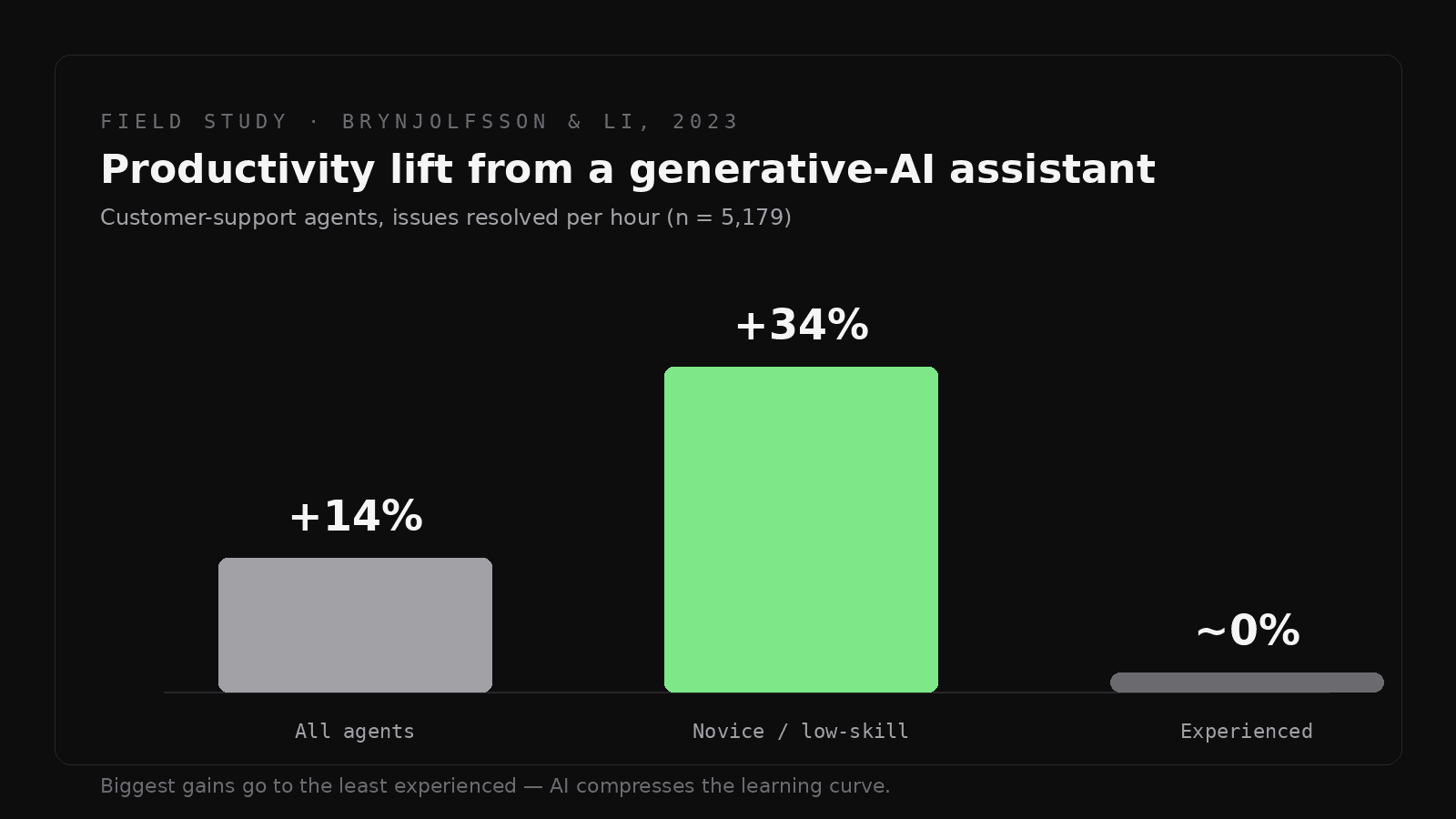
The productivity lift from a generative-AI assistant, from Brynjolfsson, Li & Raymond (2023). The gains concentrate among the least experienced.
That last finding is the interesting one for a solo founder. AI is least useful where you're already an expert, and most useful where you're a novice. A single person running a whole company is, by definition, a novice at most of it — the founder who can code is a novice at tax filing, the designer is a novice at SRE, the marketer is a novice at SQL. AI raises your floor across every discipline you're weak in, which is exactly the surface area a team used to cover.
A real shift, not a vibe
The structural numbers point the same way. According to the U.S. Census Bureau, the number of nonemployer businesses — firms with an owner and no employees — grew faster than employer businesses in nearly every year from 2012 to 2023, averaging 2.7% annual growth versus 1.1%, and spiking 4.9% in 2021. There are now well over 28 million such firms in the U.S. alone. The one-person business isn't a niche; it's the fastest-growing shape of company.
The ceiling is rising too. OpenAI's Sam Altman has repeatedly floated the idea of the first one-person billion-dollar company — something he's called unimaginable without AI. Whether or not that exact milestone lands on schedule, the direction is clear: the maximum output of a single motivated person is climbing fast.
What we actually automate (and what we don't)
The trap is automating everything because you can. The trick is to automate the work that is repetitive, well-defined, and low-stakes to get slightly wrong, and to keep a human on the work that is creative, ambiguous, or expensive to get wrong. In practice, the highest-return things to automate first are:
- Glue work between tools. Moving data between your CRM, database, email and billing. This is where tools like n8n shine — and where things quietly break, which is exactly why we built FlowVitals. If automations run your business, treat them like production software (more on that in our piece on monitoring n8n in production).
- First-draft generation. Marketing copy, documentation, code scaffolding, support replies. AI gets you to a draft in seconds; you edit instead of starting from a blank page. Editing is faster and higher-quality than creating, and it keeps a human in the loop on anything customer-facing.
- Monitoring and alerting. You cannot watch ten dashboards. Let software watch them and interrupt you only when something is actually wrong. The goal is to be notified, not to be vigilant.
What we deliberately keep human: pricing and positioning, anything touching trust or safety, the first conversation with an early customer, and the taste-level decisions about what to build next. Those are the 20% — the parts where being a human who cares is the entire product.
The portfolio mindset
A team-of-one doesn't mean betting everything on a single product. The studio model spreads ideas across a shared foundation — one design system, one infrastructure setup, one brand layer, one analytics stack — so each new app launches further ahead than the last.
That shared foundation is itself a form of leverage. The second product is cheaper to build than the first. The third is cheaper still. Automation maintains the foundation in the background so the founder can focus on what's actually different about each new bet. It's how a single person can credibly run both Clipora, a video-first conversion platform for creators, and FlowVitals, monitoring for n8n automations — two very different products sharing one spine.
A week in the studio
Concretely, here's what leverage looks like across a week. Monday's customer emails are triaged and drafted by an AI assistant — we read and send, we don't write from scratch. New sign-ups flow through an n8n workflow that provisions the account, tags the user and starts an onboarding sequence with no manual steps. Code ships with an AI pair-programmer handling boilerplate and tests while we make the architectural calls. Marketing copy, release notes and social posts start as machine drafts and get a human edit for taste and accuracy. Analytics roll up into a single daily digest instead of ten dashboards we'd never open.
None of these are exotic. Each one replaces what used to be someone's part-time job. Stacked together, they're the difference between running one product and running a portfolio.
Where this actually breaks down
Honesty matters more than hype, so here's where the model has limits. Automation amplifies whatever you point it at — including mistakes. A broken workflow that emails the wrong 5,000 people does it instantly and at scale, which is why monitoring your automations is non-negotiable. AI drafts are confidently wrong often enough that anything customer-facing or legal needs a human check. And there's a human limit too: leverage removes the busywork, but it doesn't remove the responsibility, and a company of one has no one else to carry the pager. The model works precisely because it's narrow — a focused portfolio, not an empire.
Useful beats impressive
The failure mode of "build like a team" is building like a bloated team: shipping features nobody asked for because you can. Restraint matters more when you have leverage, not less — every feature you ship is something you alone have to maintain forever.
The bar we hold every product to is simple: does it give someone their time back? If it does, it earns its place in the portfolio. If it's merely clever, it doesn't.
Where to start
If you're a solo founder, or thinking about becoming one, don't try to automate everything on day one. Pick the single most repetitive part of your week, automate that, and reinvest the time you save into the next bottleneck. Compounding does the rest.
That's the whole game: small, durable automations stacked on top of each other until one person can credibly run what used to take a team.
The takeaways
- The bottleneck was never ideas — it was the hours between an idea and a maintained product. AI and automation collapse those hours.
- AI helps you most where you're weakest, which is most of the job when you're a company of one.
- Automate the repetitive, well-defined, low-stakes work. Keep humans on the creative, ambiguous, high-stakes 20%.
- Build on a shared foundation so each new product is cheaper than the last.
- Hold every feature to one test: does it give someone their time back?
Building solo, or thinking about it? Get in touch — we like comparing notes.
References
- Brynjolfsson, E., Li, D., & Raymond, L. (2023). Generative AI at Work. NBER Working Paper 31161.
- U.S. Census Bureau (2025). Number of U.S. Nonemployers Grew Faster Than Employer Businesses Nearly Every Year From 2012 to 2023.
- Every (2024). The One-Person Billion-Dollar Company.