

Self-hosted vs cloud n8n: the real trade-offs
Self-hosted n8n is free and unlimited; Cloud is €24–60/month with hard execution caps. But the honest comparison isn't the invoice — it's what each one costs you in time, risk and 2am incidents.
TL;DR — Self-hosted n8n is genuinely free and has no execution limits; Cloud starts around €24/month and hard-stops your workflows the moment you hit the cap. But cash isn't the real axis. Self-hosting costs you maintenance, upgrades, backups and incident response — so it's cheaper only if your time is. Both fail silently, which is the risk neither pricing page mentions.
"Just self-host it, it's free" is the most common advice in the n8n community, and it's true in the narrow sense that you'll pay n8n nothing. It's also the advice most likely to cost a solo founder a weekend they didn't budget for.
The honest version of this comparison isn't a feature table. It's an argument about which resource you're shortest of — money or attention — and what happens when the thing breaks at an inconvenient hour.
What each one actually costs
Start with the invoice, because it's the simplest part.
n8n Cloud is priced on execution volume, with unlimited workflows and users on every plan. As of August 2026 that's roughly €24/month for Starter (2,500 executions), €60/month for Pro (10,000), and €800/month at the Enterprise end (40,000). The only lever on your bill is how many times your workflows run.
Self-hosted Community edition is free, with no execution limits, no workflow limits and access to the full integration catalogue. The realistic setup is a $5–7/month VPS running n8n via Docker Compose — call it $72 a year — and initial setup is genuinely 30–60 minutes if you follow a guide.
On cash alone, that's a saving of a few hundred dollars a year against Starter and thousands against the higher tiers. Which is where most comparisons stop, and where they start being misleading.
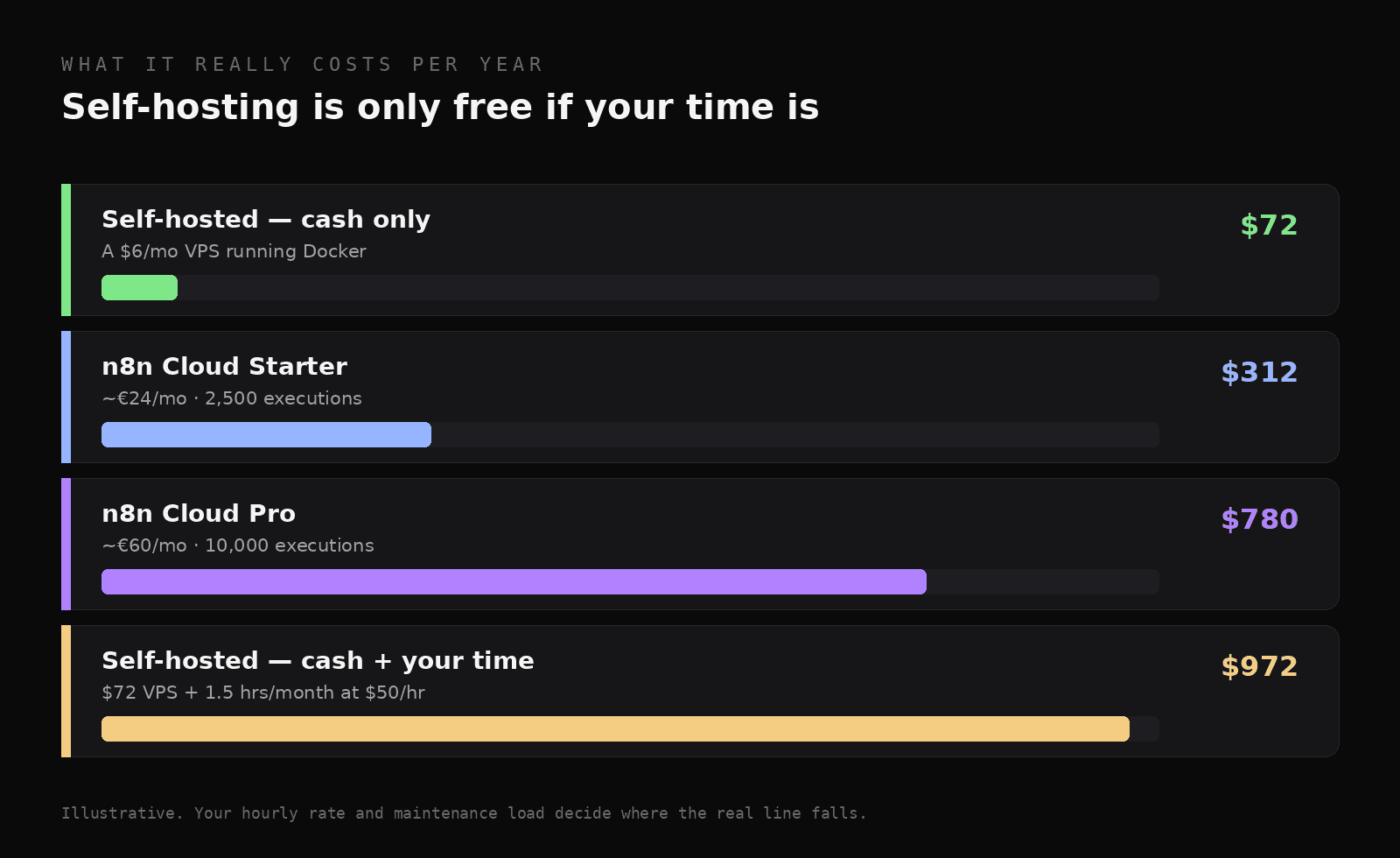
The same comparison with your time priced in.
Add the maintenance. A self-hosted instance needs updating, its database backed up, its disk watched, its SSL renewed, its occasional incident diagnosed. Call it a conservative 1.5 hours a month — and if you value your time at even $50/hour, that's $900 a year on top of the VPS. Suddenly the "free" option is the most expensive line on the chart, more than Cloud Pro.
That number isn't a reason to use Cloud. It's a reason to do the sum honestly rather than assuming free means free. If you enjoy running servers and it costs you fifteen minutes a month, self-hosting is a bargain. If it costs you a Saturday every quarter and a low hum of anxiety in between, it isn't.
The execution cap is the sharpest edge
Here's the detail that catches people, and it deserves more attention than the price:
Cloud stops your workflows when you hit the monthly execution cap. No overage billing, no grace period, no soft landing — the workflows simply stop running until the month rolls over or you upgrade.
For a business running automations, that's not a billing event, it's an outage. And it's the kind of outage that's easy to walk into: a workload of ~7,000 executions a month burns through Starter's 2,500 in about eleven days. Anything with a polling trigger, a busy webhook, or a loop that fans out across items can consume executions far faster than you'd guess from the workflow count.
So if you go Cloud, model your execution volume honestly before picking a tier, and set an alert well before the cap rather than discovering it when the leads stop arriving. Self-hosting removes this failure mode entirely — unlimited executions on hardware you control is a real advantage for spiky or high-volume work.
What self-hosting actually asks of you
The setup genuinely is easy. It's everything after that people underestimate:
- Upgrades. n8n ships fast. You'll want new nodes and security fixes, and each upgrade is a small change-management exercise with a non-zero chance of breaking something.
- Backups you've tested. Your workflow definitions and credentials live in a database. A backup you've never restored is a hope, not a backup — a point we make about every automation in the workflows every solo founder should run.
- Security. You're exposing a service that holds API keys to every system you've connected. That means TLS, patching, sensible auth and not leaving the editor open to the internet.
- Capacity. Executions consume memory and disk. Left alone, execution history quietly fills the disk and takes the instance down — a classic self-hosted n8n failure.
- Being on call. If it dies at 2am, the person who fixes it is you. With Cloud, the person who fixes it is someone whose job that is.
None of this is hard. All of it is attention, which for a solo founder is the genuinely scarce resource — the same argument we make about what to automate versus do by hand.
How to choose
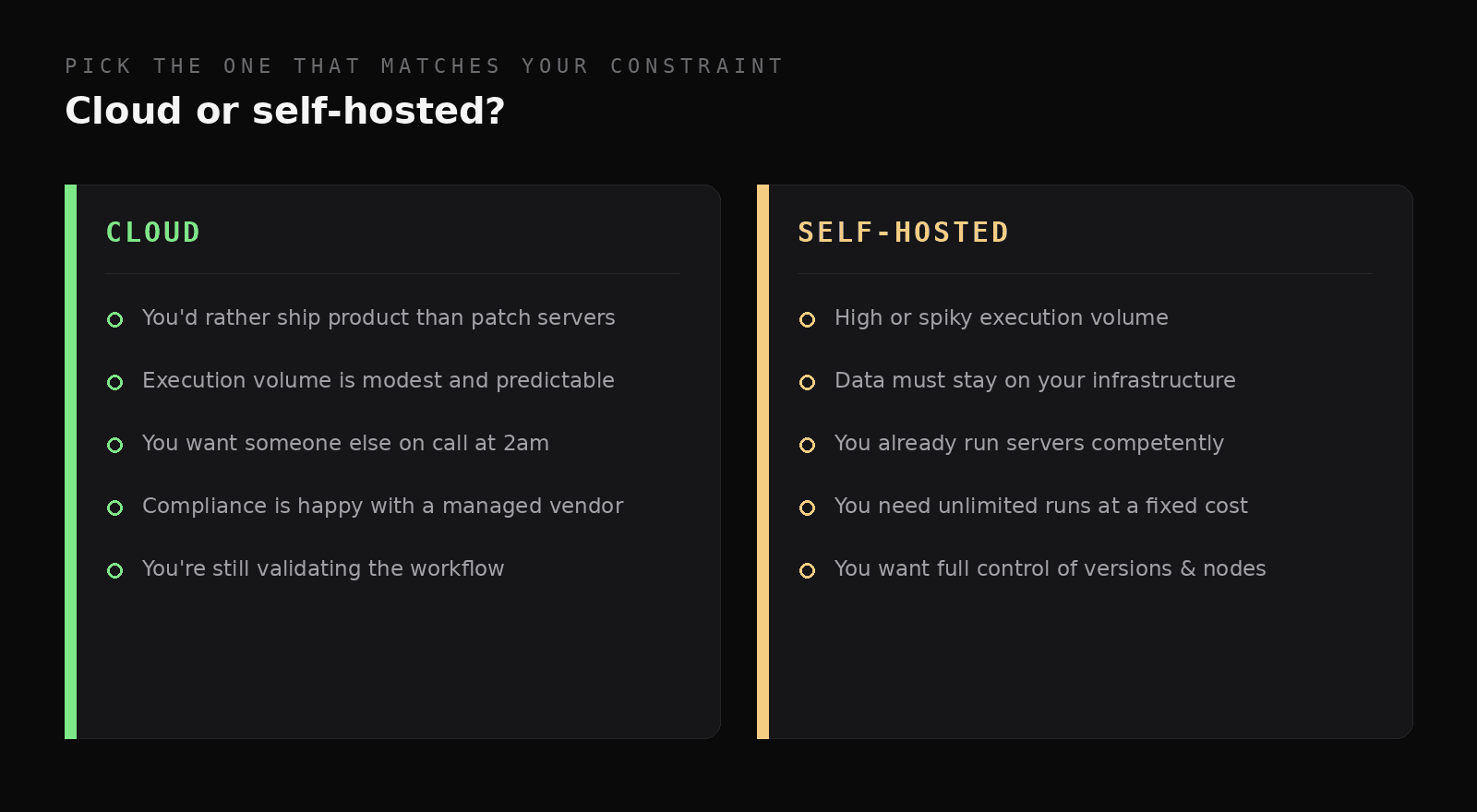
Pick based on which constraint actually binds you.
Choose Cloud if your execution volume is modest and predictable, you'd rather ship product than patch servers, compliance is happy with a managed vendor, or you're still validating whether the workflow matters at all. Paying €24 a month to not think about infrastructure is an excellent trade when you're early.
Choose self-hosted if your volume is high or spiky, your data genuinely can't leave your infrastructure, you already run servers competently, or you want unlimited runs at a fixed, predictable cost. The economics get compelling fast at scale — the difference between $72 and several thousand a year is real money for a small business.
A pragmatic middle path: start on Cloud while you're figuring out whether the automation earns its keep, and migrate to self-hosted once volume makes the maths obvious and the workflows have stopped changing weekly. Workflows export and import cleanly, so this isn't a one-way door — unlike most platform decisions.
The failure mode both options share
Here's what neither pricing page tells you, and it's the thing that actually bites.
Both fail silently. On Cloud, you hit the execution cap and your workflows stop — no error page, no angry customer, just work quietly not happening. On self-hosted, the disk fills, the container dies, or an upgrade breaks a node, and the same thing happens: nothing.
And the subtlest version affects both equally: the workflow runs, returns a cheerful 200, and processes nothing at all because an upstream API changed its response shape. Your dashboard is green. Your leads aren't being routed.
This is the whole argument from monitoring n8n in production: the question that matters isn't "is the server up?" but did the work actually happen, correctly, recently? Uptime monitoring answers the first question and tells you almost nothing about the second.
It's why we built FlowVitals to watch executions rather than availability — catching silent and broken runs, alerting the channel you actually read, and keeping versioned backups of workflows so a bad upgrade is one rollback from fixed. That layer matters regardless of which side of this decision you land on. Self-hosting doesn't remove the need for it, and neither does Cloud.
The honest summary
Cloud buys you someone else's operational attention for €24–60 a month, at the cost of a hard execution ceiling you must plan around. Self-hosting buys you unlimited runs and full control, at the cost of becoming the person responsible when it breaks.
For most solo founders early on, Cloud is the right default — not because it's cheaper, but because attention is the constraint that actually kills products, and infrastructure is the easiest place to leak it. Once volume makes the maths lopsided, move. Just don't tell yourself the free option is free.
The takeaways
- Cloud is ~€24/mo (2,500 executions) to €60/mo (10,000); self-hosted is ~$72/year on a small VPS with no limits.
- Cloud hard-stops workflows at the execution cap — no overage, no grace period. Model your volume before choosing a tier.
- Self-hosting costs 1.5+ hrs/month in upgrades, backups, security and capacity; priced at $50/hr that exceeds Cloud Pro.
- Choose on your binding constraint: money and volume favour self-hosting, attention and speed favour Cloud.
- Both fail silently — monitor executions, not uptime, whichever you pick.
Running n8n workflows your business depends on? See FlowVitals or tell us about your setup.
References
- Lowcode Agency (2026). n8n Pricing: plans, costs & hidden limits.
- ExpressTech (2026). The real cost of self-hosting n8n.
- Openhosst (2026). n8n Cloud pricing: plans, traps & fixes — execution-cap behaviour.
- n8n. Documentation and hosting guide.