

Validating a SaaS idea before you write code
42% of startups fail because nobody needed the thing — but rigorous validation cuts that below 15%. Here's the signal ladder, the cheap tests worth running, and the kill criteria that save you a year.

TL;DR — The leading cause of startup failure isn't competition or execution: 42% fail because there was no market need. Founders who validate rigorously cut that to under 15% and survive at 2–3× the rate. Validation isn't a survey — it's a ladder of signals, and everything below "someone gave me money or an hour of their time" is noise.
In how long it takes to reach $10K MRR, the number that mattered wasn't the timeline — it was that roughly 40% of micro-SaaS products never reach even $1K MRR. This post is about not being in that 40%.
Because the failure mode is remarkably consistent. Analysis of startup post-mortems puts "no market need" at around 42% of closures — the single biggest cause, ahead of running out of cash at 29%. And those two aren't independent: cash exhaustion is usually the symptom, weak product-market fit the disease. Together they account for about 71% of shutdowns.
The encouraging half: this is a research failure, not a product failure, which means it's preventable at a cost measured in weeks rather than years.
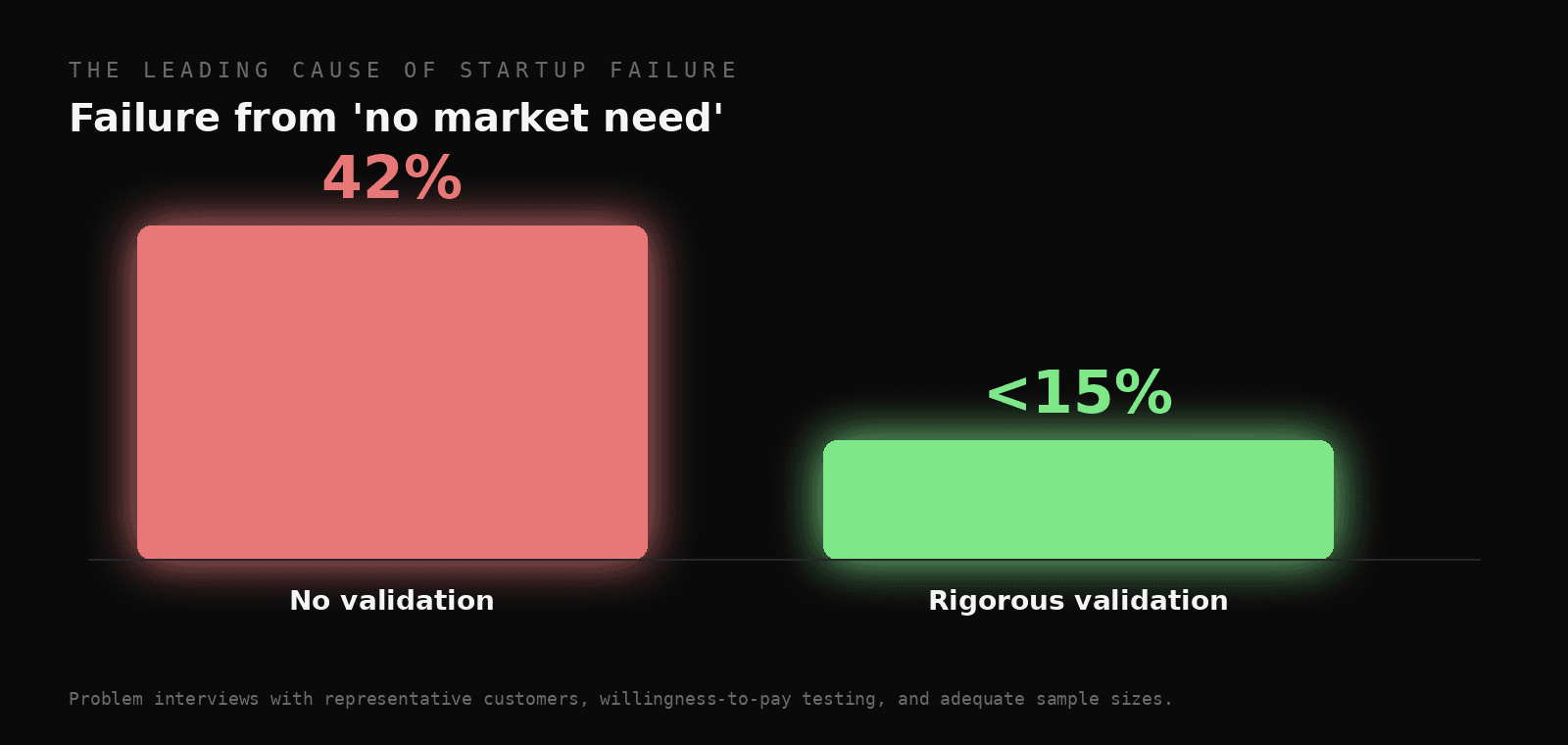
Rigorous validation — problem interviews, willingness-to-pay testing, adequate sample sizes — cuts the leading failure cause by roughly two-thirds.
Among founders who ran genuine validation — problem interviews with representative customers, willingness-to-pay testing, and enough people to mean something — failure from "no market need" drops below 15%, and validated startups show 2–3× higher survival rates. Meanwhile 54% of failed founders name understanding product-market fit as their single biggest lesson. It is, reliably, the thing people wish they'd done.
Why most "validation" is theatre
Here's the trap. Most founders do something they call validation, feel reassured, and build anyway. The problem is that the common methods are designed — accidentally — to produce encouragement rather than truth.
Asking friends and family. They like you. They will say it's a great idea. This isn't data; it's affection wearing a lab coat.
Surveys asking "would you use this?" Stated preference is close to worthless because saying yes costs nothing. People sincerely believe they'd use the gym, the meal planner, the budgeting app. Intentions are free; behaviour isn't.
Counting sign-ups for a thing that doesn't exist. Better, but weaker than it feels. An email address is one click and costs a curious person nothing. A big waitlist that converts at 2% told you about curiosity, not demand.
Asking about the solution instead of the problem. "Would you use a tool that does X?" invites people to imagine a world. "Walk me through the last time you had this problem" gets you facts. The first is a pitch with a question mark; the second is research.
The common failure across all four: you're collecting signals that cost the other person nothing.
The signal ladder
Validation gets clear once you rank evidence by what it costs the person giving it.
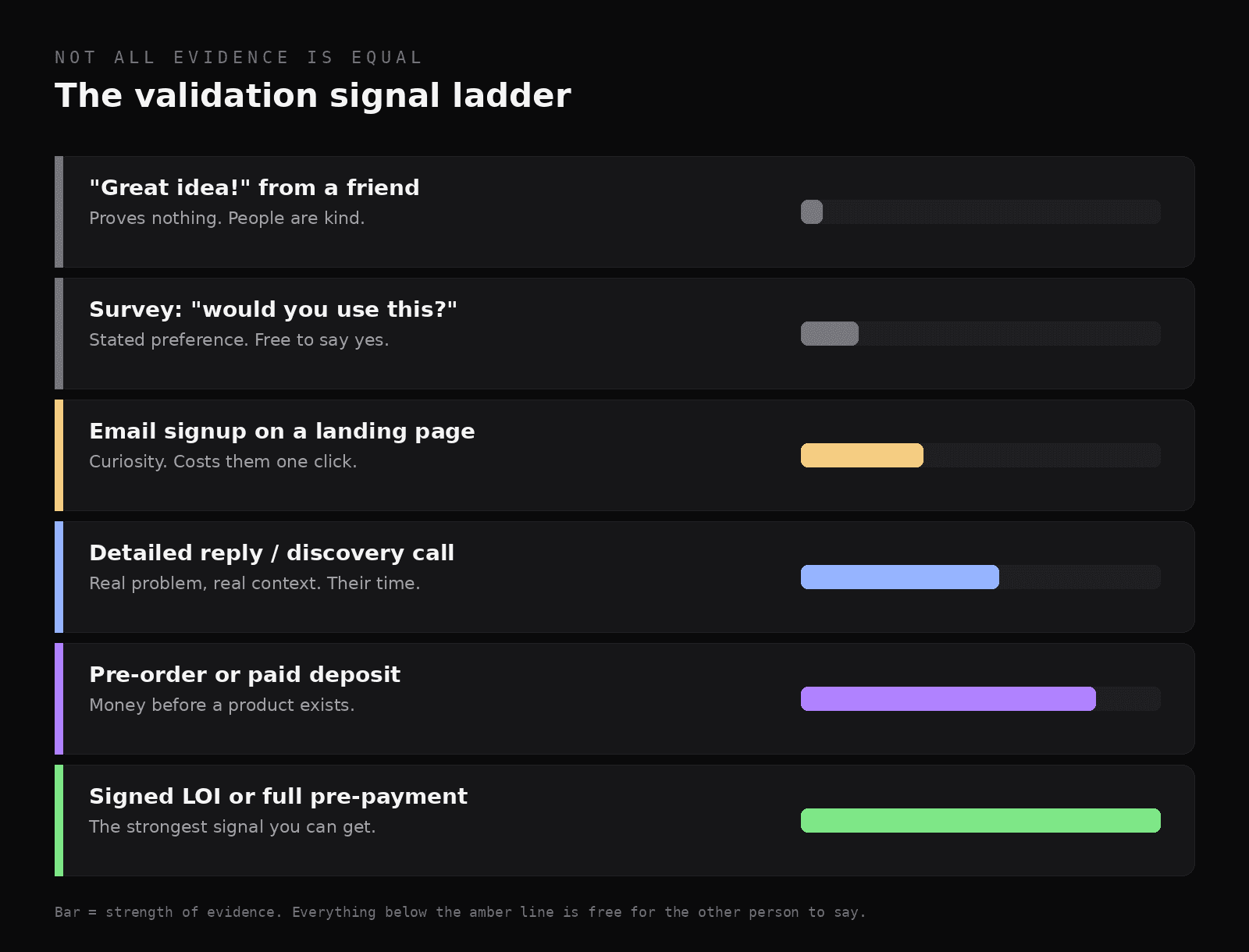
The higher the rung, the more it cost them to say yes — and the more it's worth.
Rung by rung: friendly encouragement proves nothing. A survey yes proves nothing. An email signup proves curiosity. A detailed reply or a booked discovery call proves a real problem with real context — they spent time. A pre-order or deposit proves demand, because money moved before a product existed. A signed letter of intent or full pre-payment is as strong as pre-launch evidence gets.
The practical rule: everything below the amber line is free to say, so treat it as directional at best. One person who pre-pays $200 tells you more than four hundred survey responses.
What to actually do, in order
Here's the sequence we'd run, and roughly what it costs.
1. Find the problem before you describe a solution (week 1)
Talk to ten to fifteen people who have the problem — not ten people who might. Ask exclusively about their past behaviour: when did this last happen, what did you do about it, what did it cost you, what are you using now, what did you try before that. Don't describe your idea. The moment you pitch, you've contaminated the sample, because people are polite and will help you feel good.
You're listening for two things: a problem they've already spent money or serious effort trying to solve, and consistent language describing it. If nobody's ever tried to fix it, it isn't painful enough to sell against.
2. Test willingness to pay explicitly (week 2)
This is the step most founders skip, and it's the one that most predicts survival. You don't need a product to ask. "If something solved this properly, what would that be worth to you?" and then, crucially: "we're building this — I can take a deposit today for early access at $X."
Watching someone's face when you name a real price teaches you more than any survey. And note what you're testing isn't just whether they'd pay but roughly how much — because as the $10K MRR maths shows, a product that can only support $10/month is a fundamentally different business from one that supports $200.
3. Build a landing page that asks for something (week 2–3)
A page that describes the outcome, names a price, and has a real call to action. Not "join the waitlist" — that's a curiosity meter. Better: "pre-order at 50% off," "book a 20-minute call," or "reply and tell me your setup." Anything that costs the visitor a little more than a click will separate the interested from the merely intrigued.
Send real traffic. A hundred targeted visitors from a place your buyers actually gather beats a thousand from a general audience — and it doubles as your first test of distribution, which is the thing most likely to kill you later anyway.
4. Sell it before you build it (week 3–4)
The gold standard. Take pre-orders, sign design partners, run a paid pilot, or do the job manually for two or three customers before automating any of it. Manual delivery — the "concierge" version — is enormously underrated: it validates demand, teaches you the real workflow, and produces your first testimonials, all before you've written a line of product code.
If you can't get three people to commit money or a signed intent, that's not a reason to build harder. That's the answer.
Write the kill criteria first
Validation only works if it can fail. Decide before you start what result would make you walk away, and write it down where you'll see it — because in the moment, every ambiguous signal looks like encouragement.
Ours look roughly like this:
- Fewer than 6 of 15 interviewees describe the problem unprompted → the problem isn't real enough.
- Nobody has spent money or meaningful effort trying to solve it already → no budget, no urgency.
- Zero people willing to pre-pay or commit after a direct ask → stop.
- The price people accept can't reach a viable MRR at a customer count you can actually serve solo → stop, or reposition upmarket.
A killed idea in week four is a great outcome. It cost you a month and saved you the eighteen we described in the $10K MRR post.
The uncomfortable bit
Validation feels like procrastination to builders. Building is concrete, satisfying and entirely within your control; talking to strangers about whether they'd pay you is none of those things. That asymmetry is exactly why the 42% exists — it's more comfortable to build for six months than to hear "no" in week two.
There's a subtler trap too: AI has made building so cheap that "just build it and see" sounds reasonable. Sometimes it is — if the build is genuinely a weekend. But the cost of a product was never mostly the initial build; it's the year of maintenance, support and marketing that follows. You're not risking a weekend, you're risking the next twelve months of your attention, which for a solo founder is the only scarce resource you have.
Which is also the portfolio-model argument in miniature: build on a shared foundation, validate cheaply, and you can afford to be wrong more often — because being wrong costs weeks instead of years.
The takeaways
- 42% of startups fail from "no market need"; rigorous validation cuts it below 15% and roughly doubles survival odds.
- Rank evidence by what it cost the person to give: friends and surveys are free, so they prove nothing.
- Ask about past behaviour, not future intentions — and never pitch before you've listened.
- Test willingness to pay explicitly, with a real number, before building.
- Write kill criteria in advance. Killing an idea in week four is a win, not a failure.
Working out whether an idea is worth building? Tell us about it — we like this problem.
References
- User Intuition. Why startups fail: the research on "no market need" — 42% figure and the effect of rigorous validation.
- Preuve (2026). Why startups really fail: market fit — cash exhaustion as symptom rather than cause.
- Wilbur Labs. Why Startups Fail — lessons from 200 founders.
- Demand Sage (2026). Startup failure rates and statistics.