

Distribution for builders who hate marketing
72% of successful indie hackers say distribution — not product — was the deciding factor. Here's how a solo founder who'd rather be building gets found anyway: the channels ranked by compounding, and the ones to skip.
TL;DR — Builders lose to distribution, not to better products. The fix isn't becoming a marketer; it's picking a small number of channels that compound while you build — content that ranks, an email list you own, and marketplaces that put you where buyers already are — and treating them as part of the stack, not an afterthought.
There's a specific kind of founder who reads the word "marketing" and feels tired. You'd rather be building. Shipping the next feature feels productive; posting about it feels like performing. So the product gets better every week, and nobody finds out.
Here's the uncomfortable data. In surveys of the indie-hacker community, 99% of solopreneurs cite marketing and distribution as their #1 problem, and 72% of successful ones say distribution — not product — was the deciding factor in whether they made it. Not code quality. Not features. Whether people found the thing.
That number should change how you plan your week. AI and automation have made building the easy half — a working product in weeks is now normal. Which means the bottleneck has moved. Being found is the hard part, and it deserves engineering-grade attention.
Reframe it: distribution is a system, not a personality
The reason builders hate marketing is that they picture the loud version: daily posting, growth hacks, engagement bait, being "on" all the time. That version is real, and it's also optional.
Distribution, properly understood, is a system — the set of durable paths by which people with your problem find your solution. Systems are what builders are good at. You don't need charisma to build a system; you need to pick the right channels, do the unglamorous setup once, and let them run. The goal isn't noise. It's compounding.
That's also why distribution belongs in the solo founder's stack as a first-class layer, alongside build, automate, AI and observe. A product without a distribution layer isn't a business; it's a repository.
The channels, ranked for a team of one
Not all channels suit a company of one. The filter that matters is compounding: does effort invested this month keep paying next year, or does the reach vanish the moment you stop?
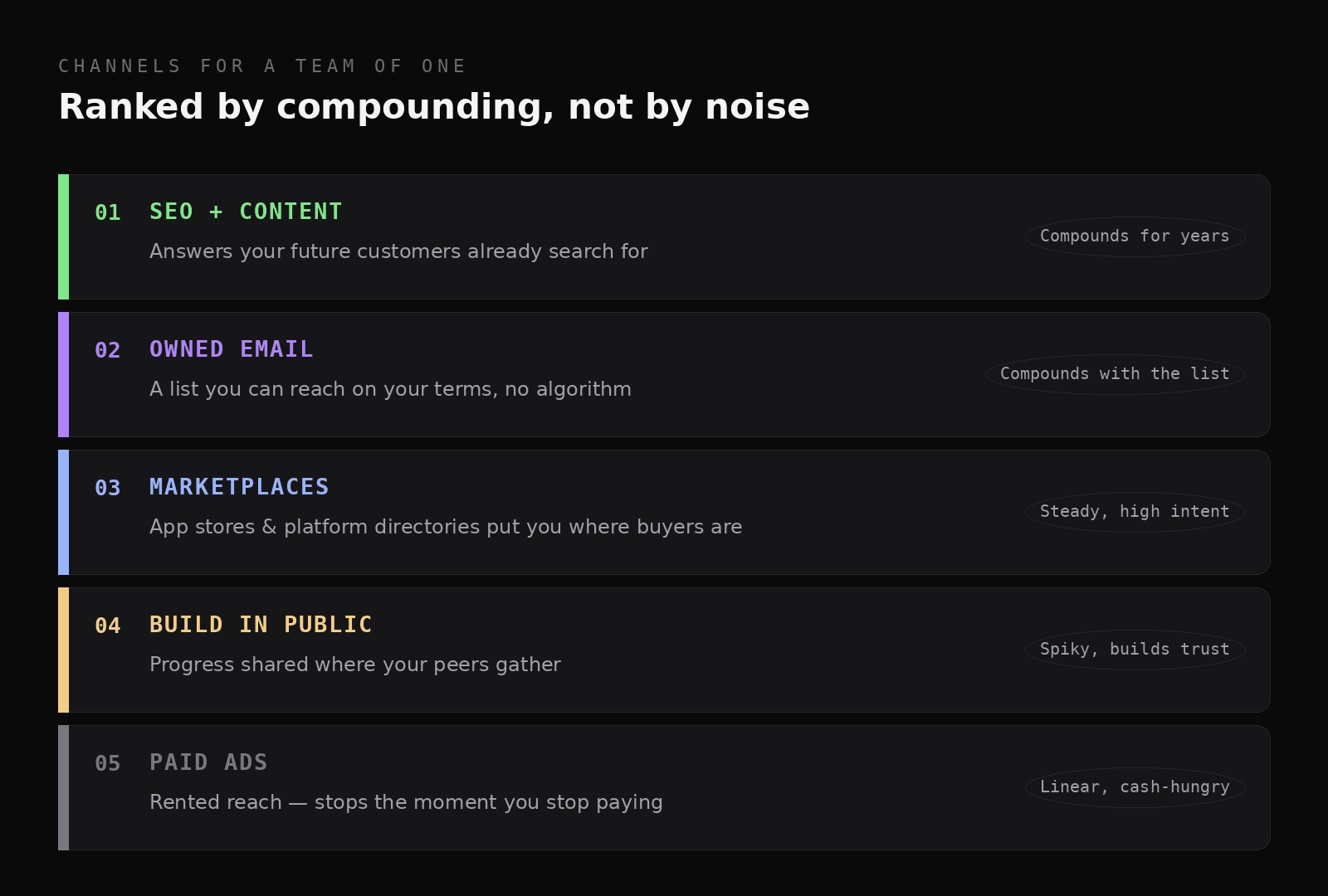
Channels for a team of one, ranked by how well the effort compounds.
1. SEO + content — the compounding core
Content that answers the questions your future customers already type into a search box is the single best fit for a builder temperament: it's asynchronous, it rewards depth over volume, and a good post keeps working for years. The craft is closer to engineering than to performing — pick a theme you can own, write genuinely useful pieces, and link them together so the depth is visible (the hub-and-spoke structure we use for this blog).
It's slow to start and that's fine. A post that ranks for one real buying question is worth more than a thousand impressions of anything viral.
2. Owned email — the asset no algorithm controls
Every channel should feed a list you own. Email remains the highest-ROI digital channel — on the order of $36–42 back per $1 spent — because you can reach the list whenever you want, on your terms. A follower is a number on someone else's platform; a subscriber is an asset on yours. This is the same "own the audience" logic we build into Clipora, and it applies to founders exactly as it does to creators. The mechanics are light: one signup path, one welcome sequence, one useful email per meaningful ship.
3. Marketplaces — go where buyers already are
The most underrated channel for builders: put the product inside a distribution surface that already has purchasing intent. App stores, plugin directories, integration galleries, platform marketplaces — these do the audience-gathering for you, and listings rank in search on their own.
We practise this one directly: Retain ships through the Whop App Store, where community owners already shop for tools, rather than fighting for cold traffic. If your product can attach to a platform's ecosystem — an n8n node, a Shopify app, a Chrome extension, a Whop app — the marketplace is the marketing.
4. Build in public — spiky but trust-building
Sharing real progress, numbers and lessons where your peers gather works — it's how much of the indie world discovers tools. But treat it honestly: it's spiky, it rewards consistency more than quality, and its audience is often other builders rather than your buyers. Use it for trust and serendipity, not as your primary engine — and route anyone it attracts onto the email list, where the relationship compounds.
5. Paid ads — rented reach, usually later
Ads aren't evil; they're just a poor fit for a solo founder's early economics. They're linear (spend stops, traffic stops), they punish small budgets, and they compete on cash against companies with more of it. The time for paid is after organic proof — when you know a page converts and you're buying acceleration, not discovering whether anyone cares.
The minimum viable distribution system
You don't need all five. A realistic system for one person is:
- One content cluster around the theme you can genuinely own — a pillar and a handful of supporting posts, published on a steady cadence.
- One owned list with a single welcome sequence, fed by every other channel.
- One marketplace or ecosystem where your buyers already shop, with a properly-finished listing.
- A monthly rhythm you can keep — one or two posts, one email, one listing improvement. Consistency beats intensity; most of the compounding channels only fail when you stop.
Then automate the plumbing around it the way you'd automate anything else (the decision rule applies): drafts machine-generated and human-edited, publishing and cross-posting wired up once, analytics rolled into the weekly digest. Distribution work should feel like running a system, not feeding a beast.
What we're doing about it ourselves
This post is the system describing itself. York Studio's distribution layer is exactly the stack above: this blog as the content cluster, aimed at the questions solo builders actually search; every post feeding internal links to the portfolio; Retain distributed through a marketplace; and the whole thing run on the same cadence discipline we apply to shipping products. We'd rather be building too — so we built the marketing like software.
The takeaways
- Distribution, not product, is the deciding factor for most successful solo founders — plan for it like a feature.
- Filter channels by compounding: content and email keep paying; ads stop when you stop.
- Marketplaces are the most underrated channel — go where buyers already are instead of gathering an audience from scratch.
- Build in public for trust, not as the engine — and route everything to a list you own.
- A one-person system is enough: one cluster, one list, one marketplace, one sustainable rhythm.
Building something good that nobody's found yet? Tell us about it.
References
- Better Launch (2026). Indie Hacker in 2026: What It Means + Real Playbook — distribution as the #1 problem and deciding factor.
- Litmus. The ROI of Email Marketing.
- Reichheld, F. / Bain & Company. The Value of Keeping the Right Customers — why retained relationships compound (see also our piece on retention as a growth channel).