

How long does it really take to reach $10K MRR solo?
The honest answer: 12–18 months is the median for bootstrapped micro-SaaS, 6–12 if you're full-time — but only 30% of products ever pass $5K MRR at all. Here's what the data says, and what actually decides which side you land on.
TL;DR — For bootstrapped micro-SaaS the median is roughly 12–18 months; full-time and focused can be 6–12; a side project is realistically 12–24. But the timeline is the less useful number. The one that matters: about 40% never reach $1K MRR and only around 30% ever pass $5K. "How long" is the wrong question — "will it compound at all" is the right one.
It's the question every indie founder types into a search bar at some point, usually late at night after a month where revenue didn't move: how long is this supposed to take?
The honest answer is unsatisfying in one direction and encouraging in another. Unsatisfying because it's slower than the launch-day stories suggest. Encouraging because the bar for a life-changing outcome is lower than most people assume — $10K MRR, at the 70–90% net margins typical of a one-person software business, is roughly $96K a year in take-home from an asset you own.
Let's do the numbers properly.
The timeline, honestly
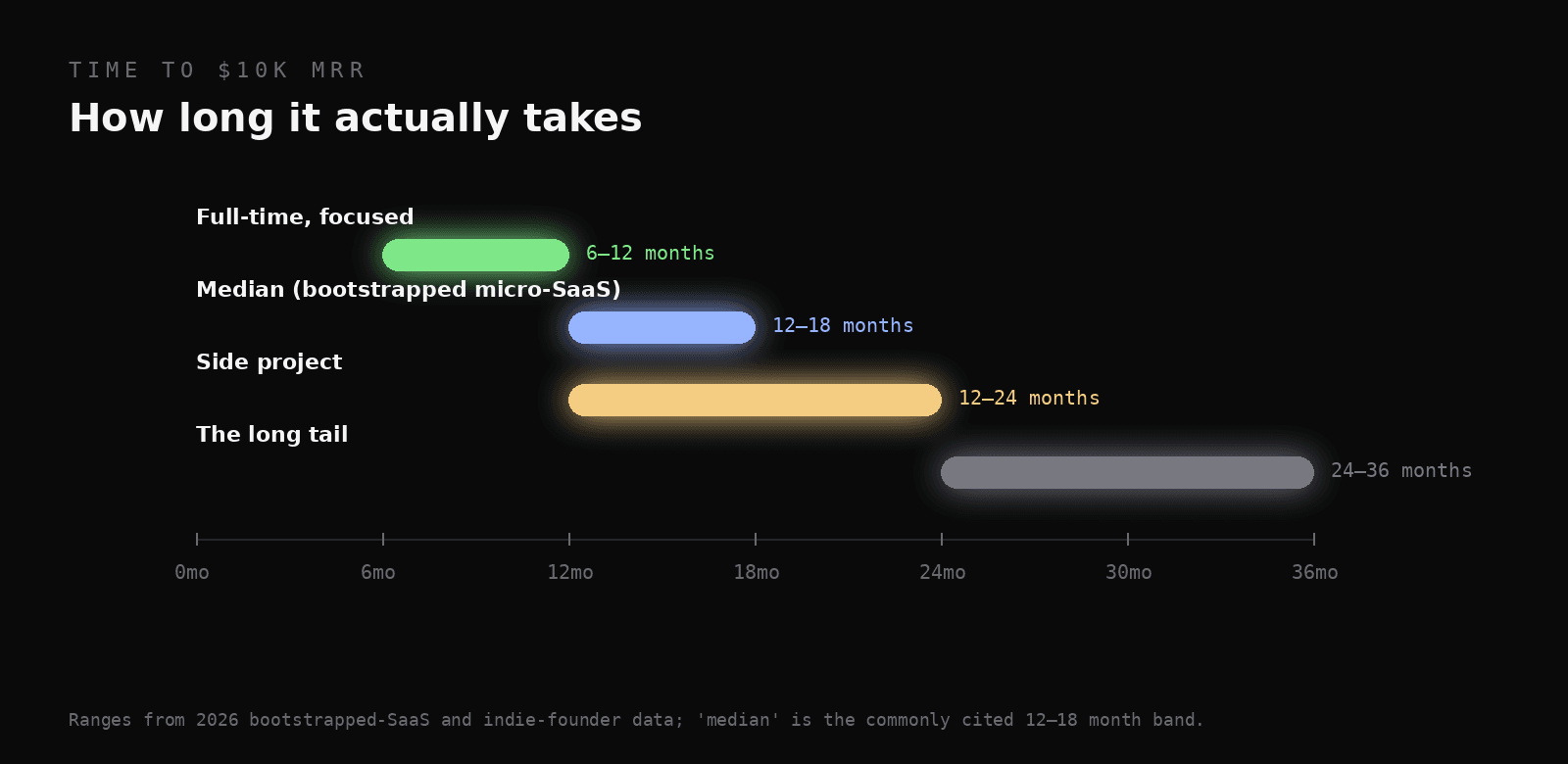
Time to $10K MRR by how you're working on it.
The commonly cited figure is that the median time to $10K MRR for bootstrapped micro-SaaS is 12–18 months. Underneath that median, commitment level drives most of the variance: a founder working on it full-time and focused typically gets there in 6–12 months, while side-hustle founders more commonly need 12–24. A meaningful tail takes two to three years.
Real examples span the range. Bannerbear, one of the better-documented indie journeys, took 16 months to cross $10K MRR. Others have done it in six. Almost nobody does it in one.
A rough progression that matches the data, assuming you're starting without an existing audience: month 1 somewhere in the hundreds, month 3 low thousands, month 6 perhaps $5K, month 12 around $10K if things are compounding. Notice the shape — the first six months look like almost nothing happening, which is precisely when most people conclude it isn't working.
The number nobody quotes
Here's the statistic that should actually shape your expectations, and it isn't a timeline at all.
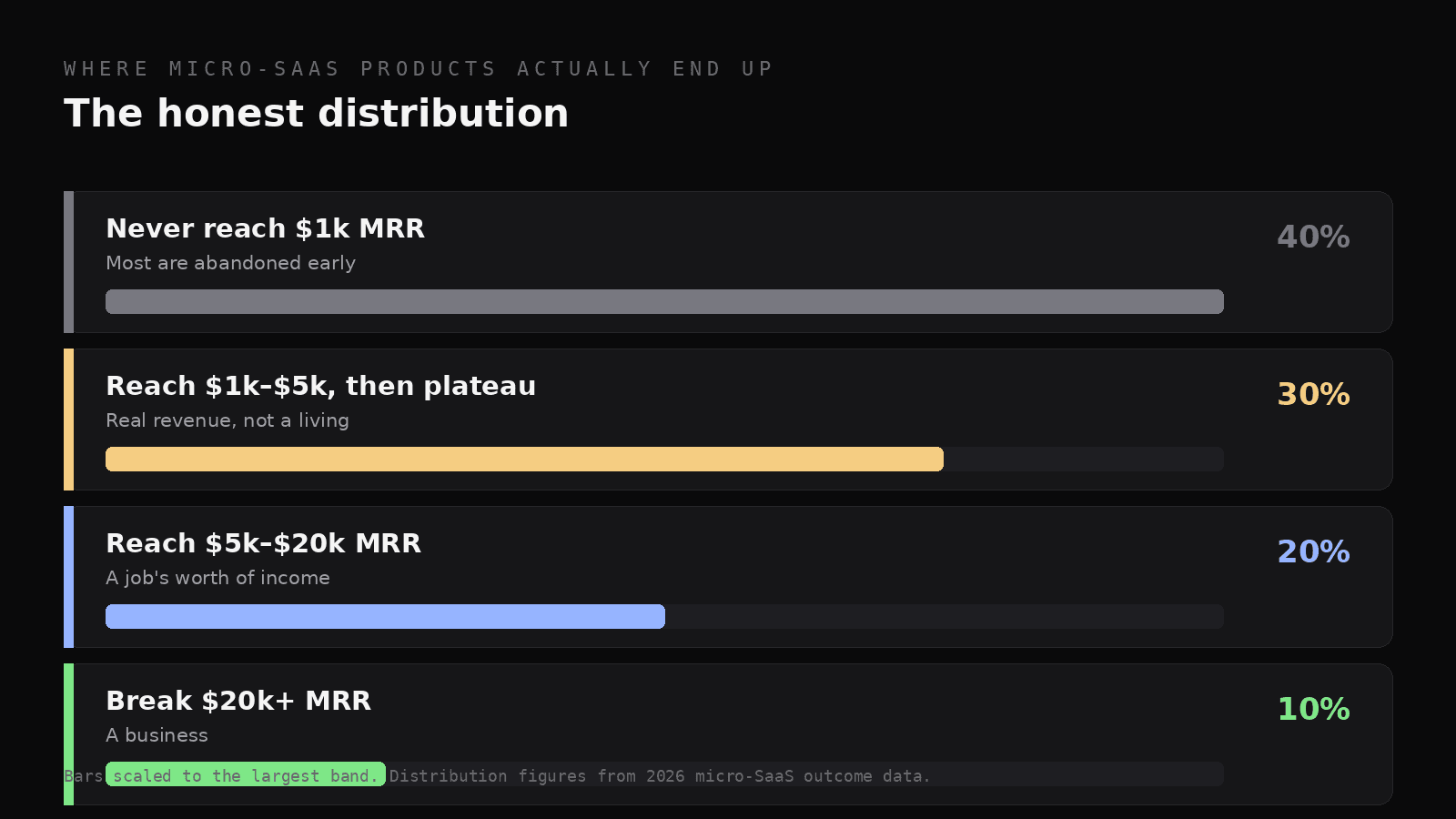
Where micro-SaaS products actually end up.
Of micro-SaaS products launched, roughly 40% never reach $1K MRR — most are abandoned long before that. Another 30% reach $1K–$5K and plateau there. About 20% land between $5K and $20K, and 10% break past $20K.
Read that again, because it reframes the question. Only about 30% of products ever get past $5K MRR. The median product doesn't take 18 months to reach $10K — the median product never reaches it. When you ask "how long will this take," you're implicitly assuming you're on the curve at all, and for most launches that assumption is the thing in question.
That's not discouragement, it's calibration. It means the real risk isn't being slow. It's building something that was never going to compound, and finding out eighteen months in.
There is a genuinely encouraging counterpart, though: bootstrapped businesses survive far better than the funded kind. Bootstrapped startups show roughly a **58% five-year survival rate against 32% for venture-backed. Low burn is a real structural advantage — you get more attempts.
What actually decides which side you land on
If 40% stall before $1K, the interesting question is what separates them. Three things do most of the work.
Distribution, not product. This is the one nobody wants to hear. In the indie community, 99% of solopreneurs cite marketing and distribution as their number one problem, and 72% of successful ones say distribution — not product quality — was the deciding factor. AI has made building fast and cheap; being found has not got easier. If you're eight months in with a good product and flat revenue, the problem is almost certainly not the product. We wrote the whole playbook on this in distribution for builders who hate marketing.
Retention, not acquisition. Early on, churn is invisible — you have too few customers for it to show. By month nine it's the thing capping your growth, because at 8% monthly churn you're replacing most of a cohort every year just to stand still. That's the compounding trap we covered in retention is the growth channel most founders ignore: every point of churn removed is a point you don't have to re-earn.
Price, not volume. Getting to $10K MRR at $10/month means a thousand customers, which for a solo founder is a support burden and a marketing problem you can't staff. At $99/month it's about a hundred. At $299 it's thirty-four. The arithmetic is brutally simple, and the most common self-inflicted wound in indie SaaS is pricing so low that the maths can never work.
Why the first six months feel like failure
The shape of the curve is the psychological problem. Compounding growth looks like nothing at all for a long time, then looks obvious in hindsight. Ten per cent monthly growth from a $500 base is $50 — an entire month of work for a number you could earn in an afternoon of freelancing. The same 10% at $8K is $800.
This is exactly where the 40% is created. Not by people whose products failed, but by people who quit during the flat part of a curve that was working. The kill criterion that matters isn't "am I at $X by month six" — it's "is the trend compounding at all?" Three consecutive months of genuine growth, even small, is a very different signal from three months of flat, and they look almost identical on a bank statement.
What we'd actually plan for
If we were setting expectations for a new product in the York Studio portfolio, it would look like this:
- Assume 12–18 months, and structure your finances so that's survivable. The single most common cause of failure isn't the product — it's running out of runway or patience before compounding shows up.
- Price for a hundred customers, not a thousand. Decide early whether you're building something that can charge $50–$300/month. If it can't, $10K MRR is a much longer road.
- Put distribution in from day one, not after launch. It's a layer of the solo founder's stack, not a phase.
- Measure the trend, not the total. Month-over-month growth rate is the honest signal; MRR is the vanity one early on.
- Set a real kill criterion. Ours is roughly: if there's no compounding trend after six months of genuine distribution effort — not six months of building — go and interview ten people who didn't convert before writing another line of code.
- Build on a shared foundation so a product that doesn't work costs you months, not years. That's the whole portfolio model argument: the second bet is cheaper than the first.
The honest summary
$10K MRR solo is achievable, it's a genuinely good outcome, and it takes about a year to eighteen months if it works at all. The uncomfortable part is that "if it works at all" is doing real load-bearing work in that sentence — most products stall well short, usually for distribution or pricing reasons rather than product ones.
The founders who get there are rarely the ones who built the best thing. They're the ones who picked something people would pay a real price for, put it in front of people repeatedly, kept the customers they won, and were still there in month fourteen.
The takeaways
- Median for bootstrapped micro-SaaS is ~12–18 months; 6–12 full-time; 12–24 as a side project.
- The distribution matters more than the median: ~40% never reach $1K MRR, only ~30% ever pass $5K.
- Distribution, retention and pricing decide which side you land on — rarely product quality.
- Compounding looks like failure for the first six months; measure the growth trend, not the total.
- Bootstrapped businesses survive better (~58% at five years vs ~32% VC-backed) — low burn buys you more attempts.
Building toward your own $10K? Tell us what you're working on.
References
- Big Ideas DB (2026). Bootstrapping a Company in 2026: How Solo Founders Hit $10K MRR Without VC — timeline bands and outcome distribution.
- Better Launch (2026). Indie Hacker in 2026: What It Means + Real Playbook — distribution as the deciding factor.
- Founderpath. Bootstrapping a Startup: Complete Guide for SaaS Founders — bootstrapped vs venture-backed survival.
- Acquire. The Roadmap for Growing a SaaS with MRR Under $10k.