

Why paid communities churn 5–10% a month — and the three causes
The average paid community loses 5–10% of members every month, and first-month churn runs 12–30%. Here's why members really leave — weak onboarding, passive drift and the value gap — and the operational fixes that keep them.
TL;DR — The average paid community loses 5–10% of its members every single month, and that small number compounds into a brutal annual hole. Members leave for three recognisable reasons — weak onboarding, passive drift and a value gap — plus failed payments nobody recovered. Fix the lifecycle, not the vibe, and you keep far more of what you worked to acquire. That's the job we built the York Revenue Suite to do.
Running a paid community feels like filling a bucket with a hole in the bottom. You do the hard, visible work — content, promotion, launches — and members pour in. Then, quietly, they leak out the bottom, and you spend next month replacing the ones you lost just to stay level. The leak has a number, and it's bigger than most owners think.
In 2026, the average monthly churn rate for paid communities sits between 5% and 10%, and first-month churn is far higher — commonly 12–30% across verticals. Those percentages sound survivable in isolation. Compounded over a year, they're anything but.
The maths nobody runs
Here's the part that catches owners off guard. Churn compounds. A 5% monthly loss doesn't mean you lose 5% of your members over a year — it means you lose them every month, on the members who are left.
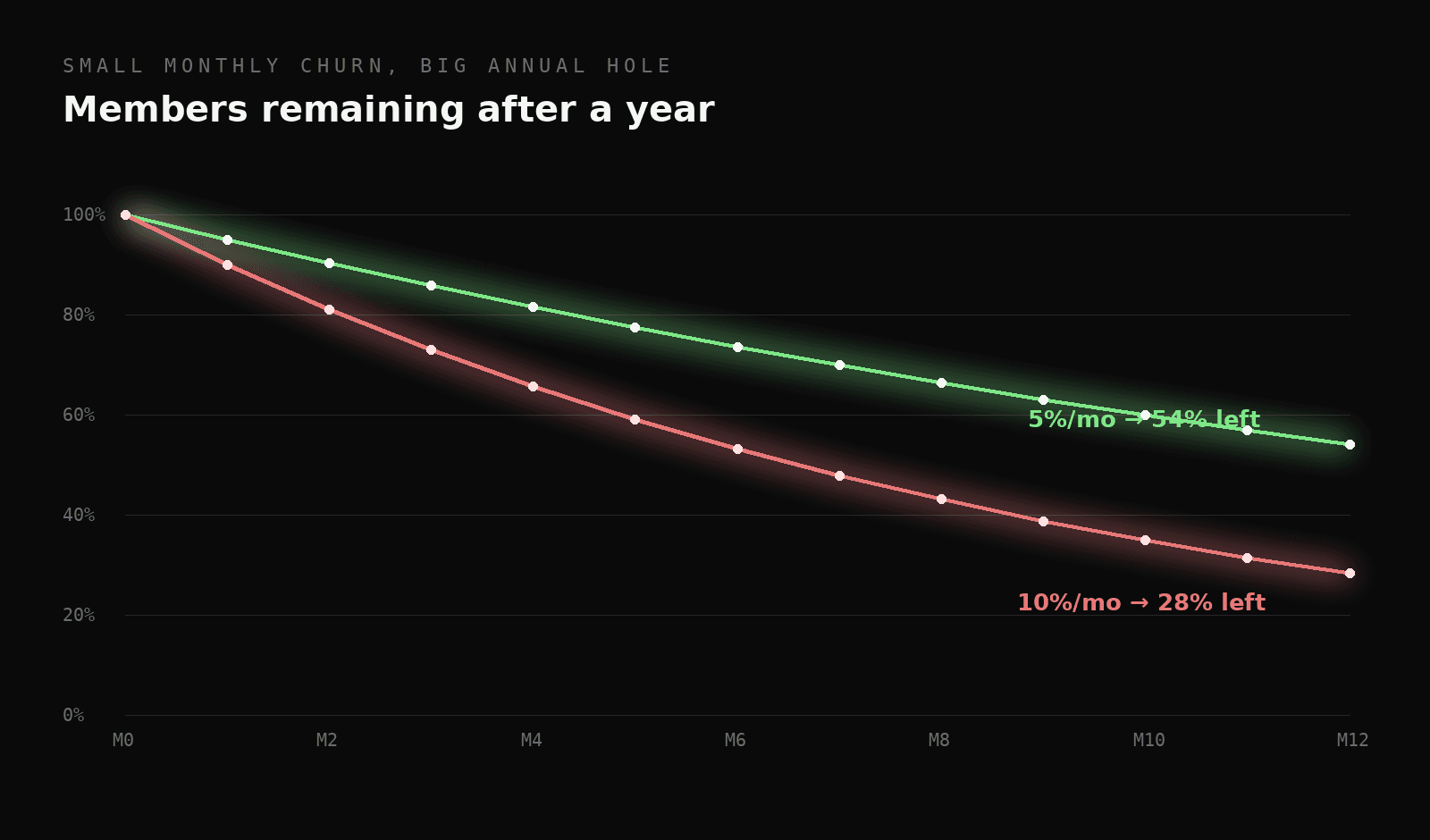
Small monthly churn, big annual hole: a cohort's survival at 5% vs 10% monthly churn.
Start the year with 100 members and add nobody. At 5% monthly churn, you finish the year with about 54 — you've lost nearly half your community without a single bad month. At 10%, you're down to roughly 28. More than seven in ten members gone, from a number that looked small on the dashboard.
This is why retention beats acquisition on pure economics. The classic Bain & Company research, published in Harvard Business Review, found that lifting retention by just 5% raises profits by 25–95%, and that winning a new customer costs five to twenty-five times more than keeping one you have. For a community, every point of churn you remove is a point you don't have to re-earn with exhausting front-of-funnel work.
So the real question isn't "how do I get more members?" It's "why are the ones I have leaving?" — and there are three answers.
Cause 1 — Weak onboarding: they never reached first value
The first and largest leak happens almost immediately. A member joins, pays, logs in once… and never reaches the thing they paid for. This isn't really churn — it's failed activation, and it's the single biggest predictor of whether someone is still around in month three.
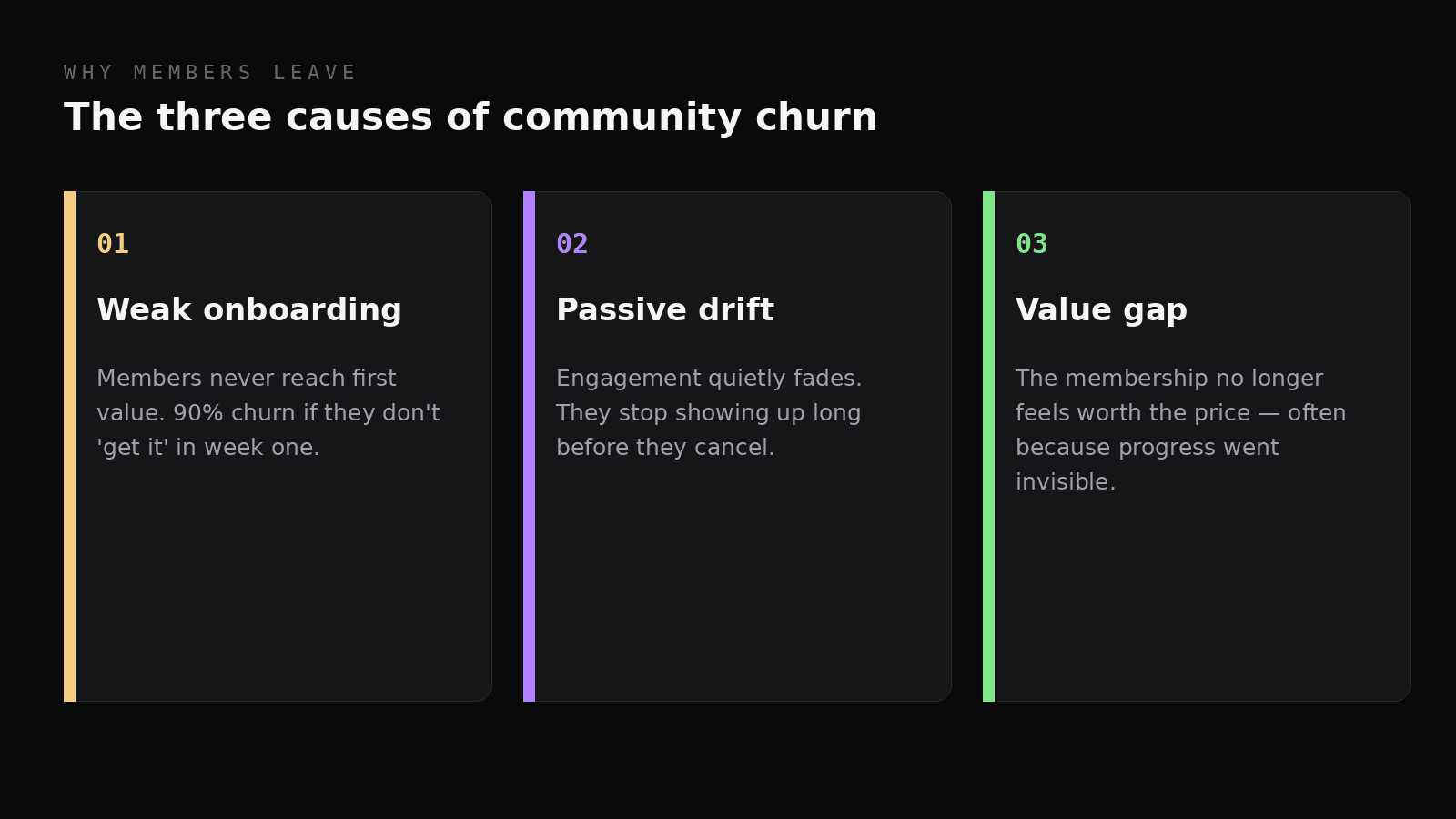
The three causes of community churn — and where in the lifecycle each one bites.
The data here is stark: research on onboarding finds that 90% of users churn if they don't understand a product's value within the first week. For a community, "first value" is concrete — a first post that gets a reply, a first module completed, a first live session attended, a first connection made. If that first meaningful moment doesn't happen fast, the member starts quietly questioning the purchase, and the clock is already running.
The fix isn't "send more welcome emails." It's designing the first session so a specific, valuable action is almost unavoidable. Point every new member at one action that proves the community was worth joining, and make it obvious. Good onboarding is worth the effort: personalised onboarding has been shown to boost retention by around 40%, and interactive first-run experiences lift activation by roughly half.
What this looks like operationally: a welcome that names the one thing to do first ("introduce yourself here and you'll get three replies today"), a nudge on day two if they haven't done it, and a light check-in in the first week. Not a drip campaign — a guided path to a single outcome.
Cause 2 — Passive drift: they stopped showing up before they cancelled
The second leak is the quietest and the most dangerous, because it's invisible until it's too late. A member is active, then a little less active, then they lurk, then one day a renewal comes up and they think "I never use this anymore" and cancel. By the time the cancellation lands, the real churn happened weeks ago.
This is passive drift, and it's lethal precisely because the member never complains — they just fade. The cancellation is the funeral, not the illness. Owners who only react to cancellations are always too late; the signal you actually want is the slowdown, not the stop.
Catching drift means watching engagement as a trend, not a snapshot. A member whose logins, posts or session attendance have quietly halved over a month is telling you something a cancellation button never will. The intervention is a timely, human re-engagement at the moment the slope turns down — a check-in, a "we saved you a seat" for the next session, a personal nudge toward the part of the community they used to value — while they're merely drifting, not gone.
The reason most communities can't do this is operational, not strategic. Watching every member's engagement curve by hand is impossible past a few dozen people; it has to be software that flags the slope and prompts the outreach. This is exactly the kind of repetitive-but-sensitive lifecycle work we think focused software should own.
Cause 3 — The value gap: the price stopped feeling worth it
The third leak is about perceived value. The member still shows up, but somewhere along the way the membership stopped feeling worth the money. Sometimes the value genuinely faded. Far more often, the value is still being delivered — it just went invisible.
Communities are especially prone to this because so much of the value is intangible: belonging, access, momentum, identity. When a member can't easily see what they've gotten — what they've learned, who they've met, what's changed since they joined — the recurring charge starts to feel like a subscription they forgot to cancel. The value didn't disappear; the evidence of it did.
Closing the value gap means making progress and payoff visible on a cadence. Remind members what they've accomplished, surface what's coming that they'd hate to miss, and reflect the community's momentum back at them. The membership has to keep quietly answering the question "why am I still paying for this?" — with a real answer the member can feel, before the renewal forces them to ask it themselves.
The fourth leak: churn you didn't even choose
There's a fourth cause that sits underneath the other three, and it has nothing to do with whether members are happy: failed payments. A card expires, a bank declines a charge, an authentication step fails — and a member who fully intended to stay is churned out by accident.
This involuntary churn is not a rounding error. Recurly's research puts it at 20–40% of all subscription churn, and the good news is that most of it is recoverable, because these members never wanted to leave in the first place. The failure was mechanical. The fix is a calm, well-timed nudge — "your renewal didn't go through, here's the one tap to fix it" — plus sensible retries, not a guilt-laden win-back campaign aimed at someone who never decided to go.
Recovering failed payments is often the single highest-ROI retention motion a community owner has, precisely because the relationship and the intent are both still intact. It's pure leak-plugging: money you already earned, walking out a door you didn't know was open.
Fixing the lifecycle, not the vibe
Notice what all four causes have in common: each one is a specific moment in the member lifecycle, and each needs a different response. Generic "we miss you" blasts fail because they treat a member who never activated the same as one who's drifting the same as one whose card just bounced. Retention gets better when the intervention matches the reason.
That's a lifecycle system, and it's more than most solo owners can run by hand. It means detecting the moment (activation stalled, engagement sloping down, renewal approaching, payment failed), choosing the right playbook for that moment, sending a timely and welcome message, stopping the instant the issue resolves, and honestly tracking what actually worked. Doing that reliably, at community scale, without spamming anyone, is an operational job — not a motivation problem.
It's the job we built the York Revenue Suite to do for Whop sellers. Its Retain module handles exactly these lifecycle moments — activation, cancellation-save, win-back and failed-payment recovery — while Convert works the top of the funnel and Insight shows the numbers, including cohort retention curves and anonymous benchmarks against communities your size. Crucially, every save is logged in a conservative attribution ledger, so you see the real revenue you kept rather than a vanity number — and suite-wide quiet hours and frequency caps make sure the whole thing stays welcome, not annoying. (For the deeper argument on why retention is a growth channel and not just a defensive metric, see our pillar piece.)
What to do this week
You don't need a platform to start — you need to pick the biggest leak and plug it:
- Measure the true number. Calculate your actual monthly churn, and split it: how much is people cancelling versus payments failing? The involuntary slice is the fastest win.
- Fix week one. Define the single first action that proves value, and make sure every new member is guided to it within their first few days. This is the highest-leverage change you can make.
- Watch the slope, not the stop. Find a way to flag members whose engagement is fading before they cancel, and reach out while they're still reachable.
- Make value visible. Put progress, wins and what's-coming in front of members on a regular cadence, so the renewal is never the first time they think about worth.
- Recover failed payments automatically. If you do only one thing, do this — it's recoverable revenue you've already earned.
The takeaways
- Paid communities churn 5–10% monthly; compounded, that's roughly half to three-quarters of a cohort gone in a year.
- Members leave for three reasons — weak onboarding, passive drift and the value gap — plus failed payments nobody recovered.
- The first week decides retention: 90% churn if they don't reach value fast. Design onboarding around one first action.
- Drift is invisible until cancellation — watch the engagement slope, not the cancel button.
- Match the intervention to the reason; generic "we miss you" messages fail. That's a lifecycle system, not a motivation problem.
Running a Whop community and watching members slip away? See the York Revenue Suite or get in touch.
References
- Communipass (2026). How to Reduce Churn in a Paid Community — 5–10% monthly benchmark and the three causes.
- Customer onboarding statistics (2026) — first-week value comprehension and onboarding impact.
- Recurly. Churn Rate Guide — involuntary churn as 20–40% of total.
- Reichheld, F. / Bain & Company. The Value of Keeping the Right Customers, Harvard Business Review.