

Failed payments: the churn you didn't earn
20–40% of subscription churn is involuntary — customers whose cards failed, not customers who chose to leave. Here's why it happens, how much is recoverable, and how to build a dunning system that recovers it without feeling like debt collection.

TL;DR — Between a fifth and two-fifths of all subscription churn is involuntary: cards that expired, banks that declined, payments that failed. These customers never decided to leave. Most of it is recoverable — smart retries get 15–21%, a good message sequence 35–45%, and the two together approach 70% — but only if you move fast and write like a helpful human rather than a collections department.
Every subscription business has two kinds of churn, and only one of them is about you.
Voluntary churn is a decision. Someone weighed the value against the price and chose to leave. That's feedback — painful, useful feedback about onboarding, value or fit, which is what we dug into in why paid communities churn.
Involuntary churn is an accident. A card expired. A bank flagged a transaction. A balance ran low for a day. The customer still wants your product — they may not even know anything happened — and they get cut off anyway. This is churn you didn't earn, and it is almost always the cheapest revenue in your business to recover.
It's also much bigger than most founders assume. Recurly's research puts involuntary churn at 20–40% of all subscription churn. If a third of your losses are mechanical rather than motivational, then the fastest retention win available to you isn't a better product — it's a better payment-failure process.
Why payments fail (and why it matters which)
The single most important idea in this whole post: failures have different causes, and the right response depends on the cause. Lump them together and you'll send an urgent "update your card" message to someone whose bank will happily approve the same charge tomorrow.
Broadly, failures fall into three buckets:
- Expired or reissued cards. The most common cause, and frequently not the customer's fault at all — banks reissue cards after fraud events, and the new number never reaches your billing system. Needs the customer to act.
- Insufficient funds or temporary declines. Genuinely transient. Often resolves within hours or days, especially around paydays. Needs patience and a retry, not panic.
- Incorrect details, geographic mismatches or suspected fraud. Needs specific action — sometimes from the customer, sometimes from their card issuer, and no amount of nudging from you will fix it directly.
Payment processors encode this distinction as soft versus hard declines. A soft decline is temporary — retry it. A hard decline is permanent — retrying is pointless and, on some networks, actively harmful to your account standing. Any recovery system worth building has to read the decline code and branch, which is precisely the "guard before you act" discipline from the workflow anatomy.
What actually gets the money back
Here's the encouraging part. Because these customers never intended to leave, the recovery rates are remarkable compared to any other retention motion.
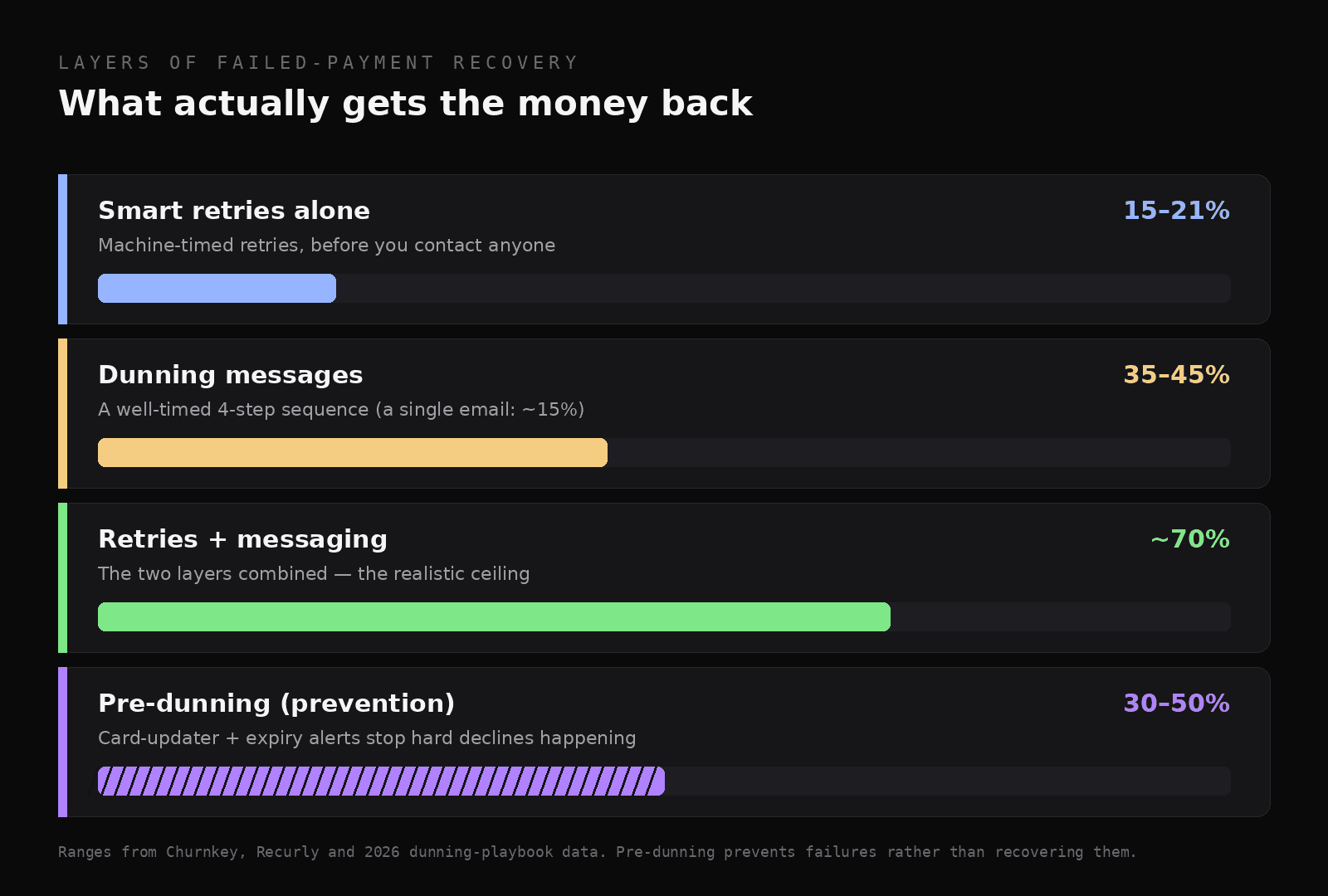
The layers of failed-payment recovery — and what each one is worth.
The layers stack, and each does a different job:
Smart retries recover 15–21% of failures before you contact anyone. Modern processors use machine-learning signals to pick retry timing — Stripe's Smart Retries, for example, spreads roughly eight attempts across two weeks and stops on hard decline codes. This is free money: silent, automatic, no customer friction at all.
Dunning messages — the emails or DMs that tell a customer their payment failed — do the heavier lifting. A single dunning email recovers about 15%. A well-timed four-step sequence recovers 35–45%. That gap between one message and a sequence is one of the highest-ROI differences in subscription operations.
Together, they approach ~70%. Churnkey's dataset shows messaging alone recovering around 42%; combined with retries it climbs toward 70%. Nothing else in retention has numbers like that, because nothing else is trying to recover customers who already want to stay.
Pre-dunning is the layer people forget, and it's prevention rather than recovery: card-updater services and expiry alerts before the charge date prevent 30–50% of hard declines from happening at all. The cheapest failed payment is the one that never fails.
Speed is the whole game
If you take one operational lesson from this post, take this one: recovery decays fast.
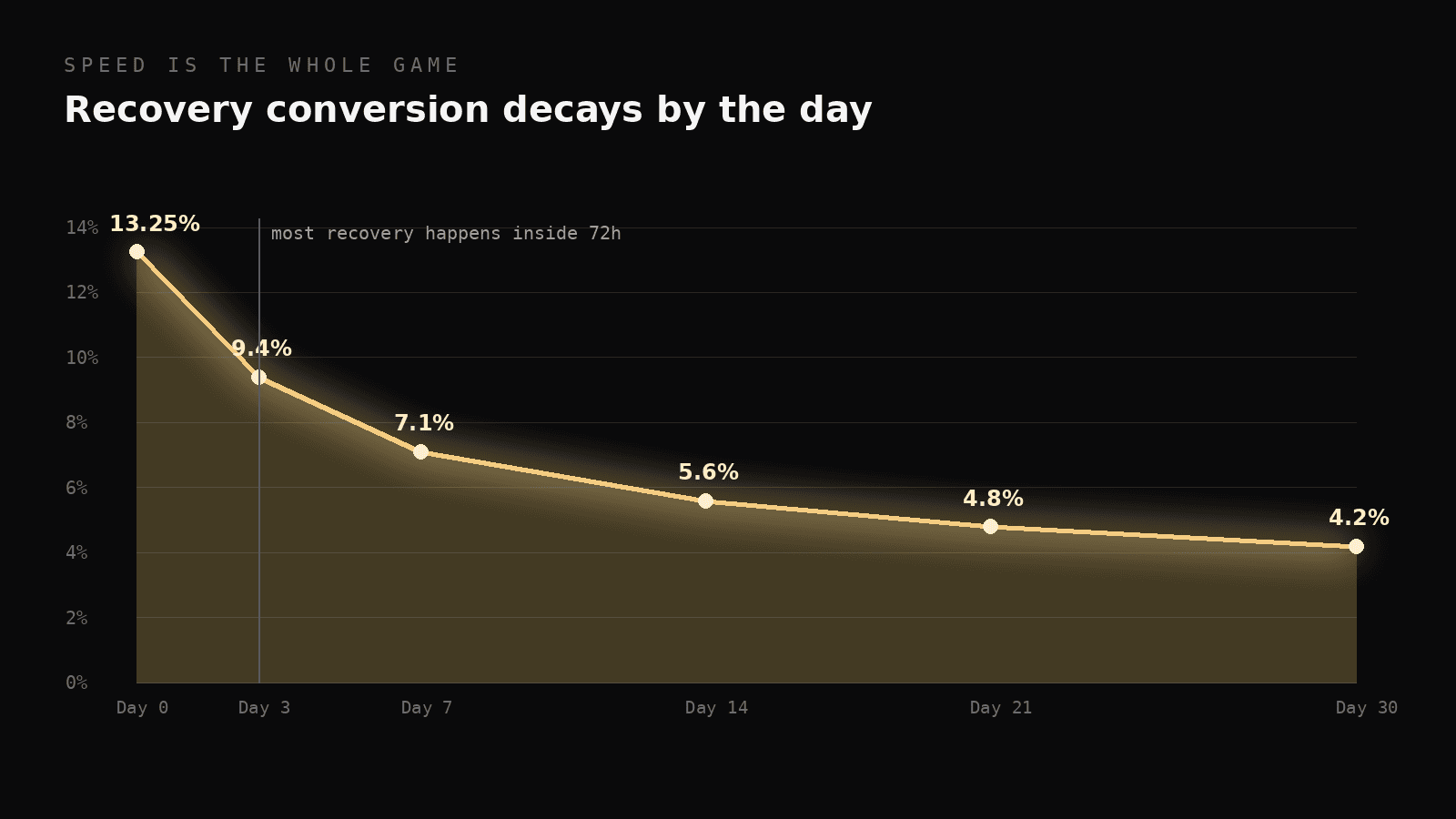
Conversion by day since failure — the first 72 hours carry most of the value.
Day-zero messages convert at around 13.25%. By day 30, the same message is worth 4.2% — still worth sending, but a third as effective. Most recovery happens inside the first 72 hours, and the curve decays sharply after two weeks.
The practical implication is that your first message should go out within about an hour of the failure. Not the next morning, not in the next batch — within the hour, while the customer still has context and their card is still in reach. This is exactly the kind of latency you can't hit manually and don't have to: it's a webhook and a workflow, which is why failed-payment alerting made our list of workflows every solo founder should run.
Writing dunning that doesn't feel like debt collection
The tone problem is real. The word "dunning" literally comes from debt collection, and a lot of dunning copy still reads that way — urgent, faintly accusatory, all-caps subject lines about ACCOUNT SUSPENSION. It's the wrong register entirely, because the person reading it hasn't done anything wrong. Their card just broke.
Dunning messages convert better when they read as helpful rather than as a collections notice. What that means in practice:
- Lead with the fact, not the threat. "Your renewal didn't go through" is information. "Your account will be terminated" is a threat aimed at someone who wanted to pay you.
- Make the fix one tap. A deep link straight to the payment-update screen, pre-authenticated where possible. Every extra step is recovery you lose.
- Match the message to the decline reason. Expired card → ask directly for new details. Insufficient funds → softer language, mention the scheduled retry, give it a beat. Suspected fraud → point them at their bank, because you can't fix it and neither can they from your side.
- Assume good faith and say so. "This usually just means a card expired" removes embarrassment and gets people acting instead of feeling caught out.
- Stop the instant it resolves. The fastest way to sour a recovered customer is to keep nagging them about a payment they already fixed. A sequence that doesn't check state before each send isn't finished.
- Don't stack it with your other messaging. If a member is already getting onboarding or win-back messages, a payment nudge on top is a bad day. Frequency caps need to be global, not per-campaign.
Escalation should be gentle across the window: a factual heads-up on day zero, a helpful reminder a couple of days in, a clear "access ends soon" as the deadline approaches, and a final message that makes returning easy rather than punishing the departure.
Count the recovery honestly
Here's a trap worth naming, because it's the one we felt strongly enough about to build a product around. If your processor is running eight automatic retries in the background and you're also sending messages, which one recovered the payment?
The lazy answer is to credit every recovery to your messaging and report a big impressive number. That number is fiction, and worse, it's a fiction you'll make decisions on. If you can't distinguish "the retry worked" from "the nudge worked," you can't tell whether your dunning copy is any good, and you can't justify the work.
Honest attribution means: only count a save when the customer acted after a message, inside a defined window, in a way the automatic retry can't explain — and be explicit when a figure is estimated rather than known. That's how the ledger in our York Revenue Suite works: conservative, windowed, message-preconditioned, and honest about the platform's own auto-retries, so the recovered-revenue number is one an owner can actually trust rather than a vanity metric. It's the same argument as our retention pillar — measured modestly, retention is a growth channel; measured dishonestly, it's just theatre.
Building it: the minimum viable dunning system
You don't need a platform to start. You need six things:
- A webhook on payment failure. Everything else hangs off this. If you learn about failures from your monthly statement, nothing below matters.
- Decline-code branching. Soft decline → let retries run, message gently. Hard decline → ask for new card details immediately, because retrying won't help.
- A first message inside the hour, with a one-tap payment-update link.
- A short sequence, not a single email — roughly four touches across two to three weeks, front-loaded because of the decay curve.
- State checks before every send, so the sequence stops dead the moment the payment succeeds.
- Pre-dunning, once the rest works: card-expiry alerts before the charge date, and a card-updater service if your processor offers one.
For most subscription businesses, this is a weekend of work and the highest-ROI retention project on the list — because unlike every other retention initiative, you're not persuading anyone of anything. You're just fixing a broken pipe between a customer who wants to pay and a business that wants to be paid.
The takeaways
- 20–40% of subscription churn is involuntary — accidents, not decisions, and mostly recoverable.
- Failures differ: expired cards need action, insufficient funds need patience, hard declines need a different message entirely.
- Smart retries recover 15–21%; a four-step sequence 35–45%; together they approach ~70%. Pre-dunning prevents 30–50% of hard declines.
- Speed dominates: day-0 messages convert ~13%, day-30 ~4%. Send the first one within the hour.
- Write helpfully, not like a collections notice — and count recoveries conservatively, or you're just flattering yourself.
Running a Whop community and losing members to failed cards? See the York Revenue Suite or get in touch.
References
- Recurly. Churn Rate Guide — involuntary churn as 20–40% of total churn.
- Digital Applied (2026). Failed-Payment Recovery: The Dunning Playbook — retry, dunning and pre-dunning recovery rates; day-by-day conversion.
- Revova. What Is Dunning? The Complete Guide to Payment-Failure Emails — tone, timing and sequencing.
- ProsperStack. Subscription Dunning — sequence structure and recovery benchmarks.