

Discord vs Whop vs Skool: where paid communities actually retain
A practical comparison of the three main paid-community platforms in 2026 — real fees, eligibility, tooling and the retention dynamics nobody mentions. Which one keeps members, and which one quietly costs you the most.
TL;DR — Discord is a chat culture that bolts on payments; Skool is a tidy course-and-community product that handles your tax; Whop is a storefront with real distribution and an app ecosystem. Fees differ more than the marketing suggests, and the platform you pick quietly shapes your churn. Below: the actual numbers as of August 2026, and the retention dynamics nobody puts on a pricing page.
Most "best platform for paid communities" posts compare feature checklists. That's the least interesting axis. All three of these will host a paid community perfectly well — the differences that matter are what they cost you at your revenue level, who they let in, and, most overlooked, how each platform's culture affects whether members stay.
That last one is the point of this post. As we covered in why paid communities churn, the average paid community loses 5–10% of members monthly. Your platform doesn't cause that — but it does make some of the causes easier or harder to fix.
Everything below reflects published terms as of August 2026. All three change pricing; verify before you commit.
The short version
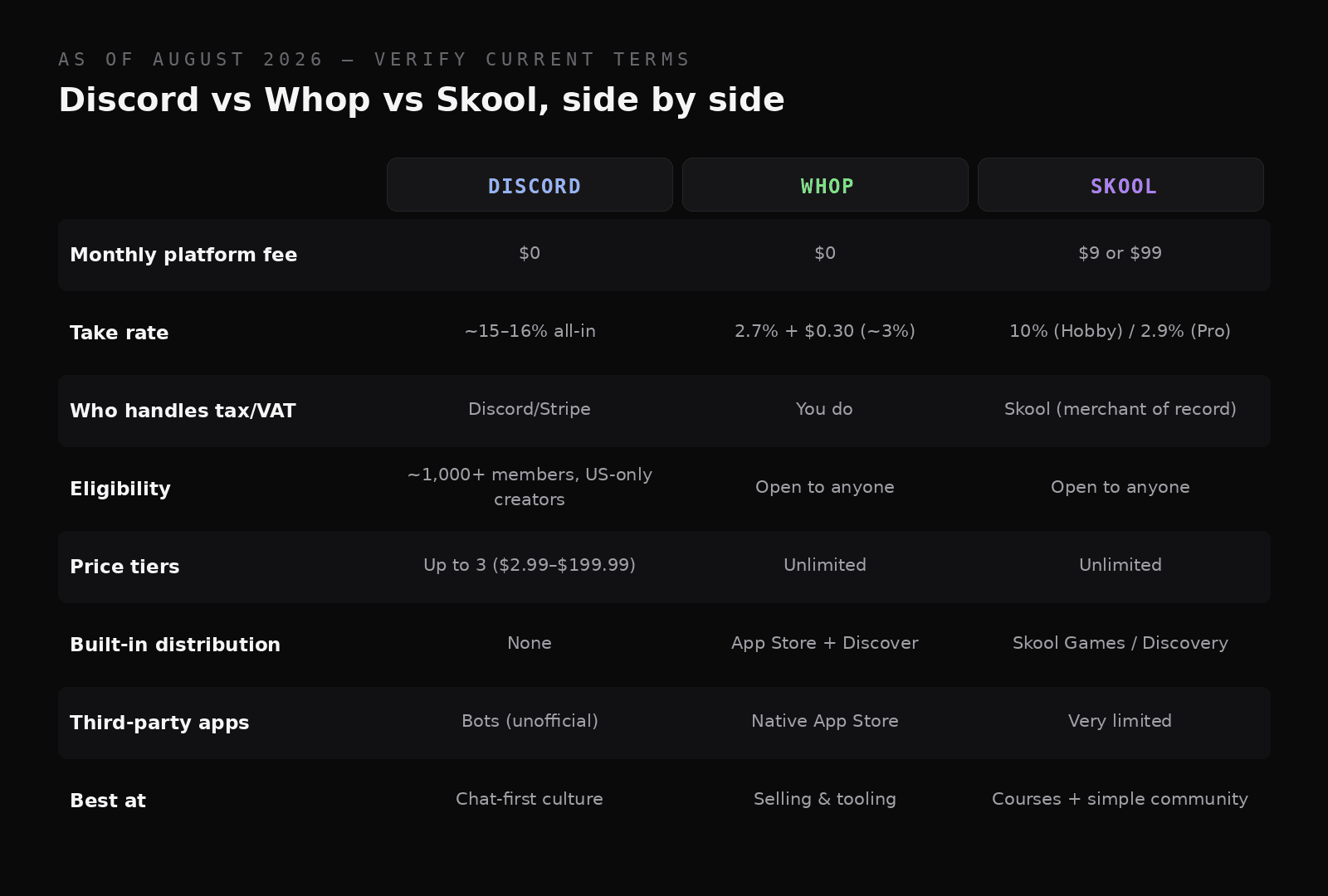
Discord vs Whop vs Skool on the dimensions that actually differ.
- Discord — free to run, chat-first, enormous cultural gravity. But Server Subscriptions take roughly 15–16% all-in, cap you at three tiers, and are gated: typically ~1,000+ members and, critically, US-only creators with a US bank account and government ID.
- Whop — $0/month, 2.7% + $0.30 per transaction (~3% all-in on US cards). It dropped its old 30% marketplace commission in May 2025. Unlimited tiers, a genuine App Store, and marketplace discovery. You handle your own VAT and sales tax.
- Skool — $9/mo (10% transaction fee) or $99/mo (2.9%), roughly 17% off annually. Clean course-plus-community product, and it acts as merchant of record — handling VAT, global tax compliance and disputes for you.
What each one actually costs
Fees are where the marketing is thinnest, so here's the arithmetic.
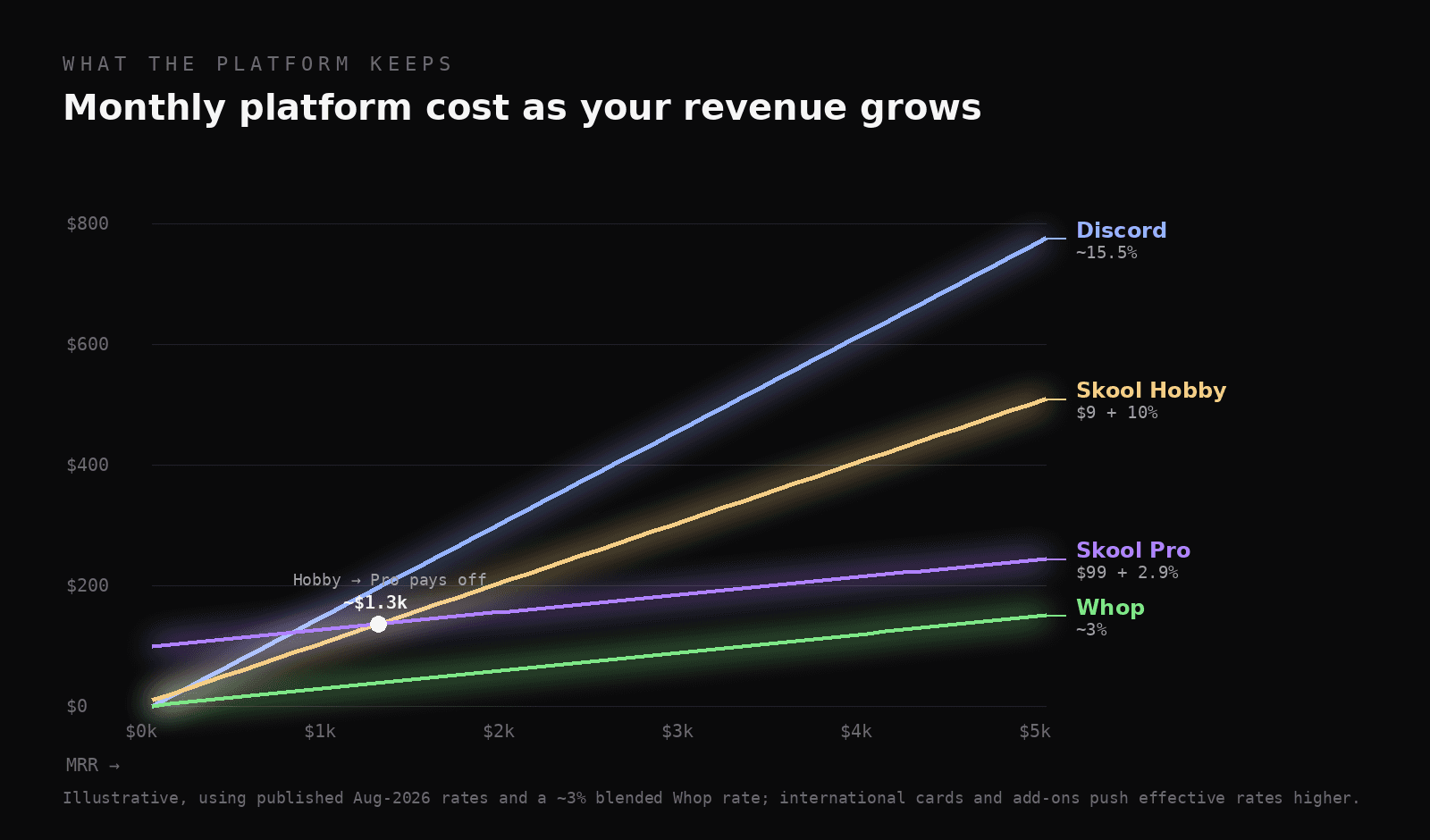
Monthly platform cost as revenue grows — the lines cross in places that matter.
Two things jump out. First, Discord is by far the most expensive way to charge for a community at any meaningful revenue. That ~15.5% effective rate isn't a headline number — Discord's 10% cut is applied after tax and processing fees, so a $100 subscription nets closer to $84–85, not $90. At $3k MRR that's roughly $465/month to the platform.
Second, Skool's two tiers cross over around $1.3k MRR. Below that, the $9 Hobby plan wins despite its 10% fee; above it, the $99 Pro plan's 2.9% rate is cheaper. If you're on Hobby past ~$1,300/month you're donating money.
The Whop-versus-Skool-Pro comparison is the genuinely close one, and it depends on your card mix. At Whop's base ~3%, Whop stays cheaper at every level on this chart. But blended rates rise with international cards and optional add-ons — at an effective ~5.7%, Skool Pro becomes cheaper somewhere around $3.3k MRR. So the honest answer is: model it with your actual blended rate rather than the headline one.
And don't forget the hidden cost line: Skool being merchant of record has real financial value if you sell into the EU or UK. Handling VAT registration and remittance yourself is either an accountant's fee or your weekends. On Whop, that's your problem.
The retention dynamics nobody mentions
Here's where the choice actually bites, and none of it appears on a pricing page.
Discord's free-tool gravity works against you. Discord trained a generation of users to expect servers to cost $0. Flipping to paid inside the same server triggers churn and public complaints in a way that Skool or Whop communities simply don't see, because on those platforms paying is the default assumption. You're fighting the platform's own norms.
Chat-first design makes drift invisible. Discord is a river. It's superb for a live, buzzing culture, and terrible for demonstrating durable value — a member who stops reading has no artefact to come back to, and you have almost no signal that they've faded. That's passive drift, the quietest and most lethal churn cause, made structurally harder to detect.
Skool's structure helps activation, by design. Courses and a single tidy feed give a new member an obvious first action — start module one — which directly serves the thing that decides retention: reaching first value in week one. The trade-off is less flexibility and a much thinner ecosystem when you want behaviour the platform doesn't offer.
Whop's ecosystem is the operational escape hatch. Whop is a storefront first, which means it treats you as a seller rather than a chat host: unlimited tiers, real checkout, marketplace discovery, and — the part that matters for retention — a native App Store where third-party tools can plug into your community's lifecycle events. If you want automated failed-payment recovery or cancel-save flows, you can install them rather than build them.
That's a structural advantage, and I should be transparent that we benefit from it: our York Revenue Suite ships on Whop precisely because the platform exposes the lifecycle hooks and the distribution to reach sellers. On Discord you'd be writing a bot; on Skool you'd mostly be out of luck.
Which should you pick?
Choose Discord if your community is fundamentally a hangout, your audience already lives there, and monetisation is secondary — or you're gating a small perk tier rather than running a business. Accept that you'll pay the highest rate, that you must be a US creator, and that you'll have the least visibility into who's quietly leaving.
Choose Skool if your product is primarily content — a course, a curriculum, a coaching programme — you want the least operational overhead, and you sell internationally enough that having someone else own VAT is worth real money. Go Pro the moment you clear ~$1.3k MRR.
Choose Whop if you're running a business rather than a hangout: multiple products or tiers, you want the lowest transaction cost at modest scale, you value marketplace discovery as a distribution channel (a point we make more broadly in distribution for builders who hate marketing), and you want to plug in tooling instead of building it. Budget for your own tax compliance.
A note on switching. Migrating a paid community is genuinely painful — every member has to re-enter payment details, and you will lose some purely to the friction. That makes this a decision worth modelling properly up front, and it's an argument against optimising for a $20/month fee difference. Pick for the shape of your business in two years.
The platforms we left out (and why)
Three names come up constantly in this comparison, so briefly:
Circle is the polished, higher-end option — excellent product, strong branding control, and priced accordingly with a real monthly fee rather than a small transaction cut. It's a reasonable choice if community is your product and you're past the point where a monthly platform bill matters. It's overkill at $500 MRR.
Patreon is a membership platform, not a community platform. It's built around supporting a creator rather than members interacting with each other, and its tooling reflects that. If what you're selling is access to you, it's fine; if you're selling access to each other, it isn't.
Kajabi and the course platforms solve a different problem — they're course-first with community bolted on, where Skool is community-and-course from the start. If your entire product is a curriculum with no ongoing discussion, a course platform is a cleaner fit than any of the three above.
The reason we focused on Discord, Whop and Skool is that they're the three where the same creator credibly agonises between them — similar audience, wildly different economics and culture.
Questions to ask before you commit
Rather than a feature checklist, these are the questions that actually predict regret:
- What's my blended transaction rate, not the headline one? Work out your real mix of domestic, international and add-on fees, then re-run the maths. The crossovers move a lot.
- Who owns my tax compliance? If you sell into the EU or UK, "merchant of record" is worth real money — either in accountant fees saved or weekends reclaimed.
- Am I eligible at all? Discord's ~1,000-member threshold and US-only creator requirement rule it out for a lot of people before economics even enter the conversation.
- Can I see who's fading? Ask concretely: does the platform show me engagement over time, or only a member list? If it's the latter, drift will be invisible to you.
- Can I install tooling, or do I have to build it? An ecosystem means the retention work, the analytics and the automation are a purchase rather than a project.
- Where do my buyers already shop? Marketplace discovery is a real acquisition channel on Whop and Skool, and non-existent on Discord — you bring all your own traffic.
- How painful is leaving? Assume you'll want to move eventually, and check whether you can export member and payment relationships in any useful form.
The part that's true on every platform
Whichever you choose, the platform will not retain your members for you. All three give you payments, access control and a place to talk. None of them, natively, will notice that a member's engagement has halved, or run a save sequence when someone cancels, or recover the 20–40% of churn that's just failed cards.
That work is the same on Discord, Whop and Skool: detect the lifecycle moment, respond appropriately, measure honestly. The platform decides how easy it is to do — which is the real reason it's worth choosing deliberately.
The takeaways
- Discord is the most expensive route (~15–16% all-in, applied after processing), tier-capped and US-creator-only.
- Skool's plans cross over at ~$1.3k MRR — staying on Hobby past that costs you money.
- Whop is cheapest at modest scale (~3% base, $0/month) but you own your own VAT and sales tax.
- Retention dynamics differ: Discord's free-culture norms and chat-first design hide drift; Skool's structure aids activation; Whop's App Store lets you install lifecycle tooling.
- No platform retains members for you — that's a system you run on top of whichever one you pick.
Running a Whop community and want the retention layer handled? See the York Revenue Suite or get in touch.
References
- Discord. Announcing Server Subscriptions and the Creator Portal.
- Learning Revolution (2026). Skool vs Whop: comparison and verdict — plan pricing and fee structures.
- Whop. Managing churn and retention in premium Discord communities.
- Communipass (2026). How to reduce churn in a paid community — the 5–10% monthly benchmark.