

Cancellation flows that don't train discount-hunters
A good cancel flow saves 15–25% of leavers, and reason-matched offers reach 30–42%. A lazy one teaches customers that threatening to cancel gets a discount. Here's how to build the first kind.
TL;DR — Processing cancellations instantly saves nobody. A structured flow saves 15–25%, and offers matched to the stated reason reach 30–42% — while a single generic discount manages 10–15% and quietly teaches customers that threatening to leave gets a cheaper price. Ask why first, offer second, and let people leave when leaving is the right answer.
Somewhere in your product is a cancel button, and what happens after someone clicks it is one of the least-designed, highest-leverage surfaces in the whole business.
The two common approaches are both bad. The first is to process the cancellation instantly with no questions — clean and respectful, but you learn nothing and save nobody. The second is to throw a discount at everyone who reaches the exit, which works just often enough to feel clever while quietly training your customers that the way to get a lower price is to threaten to leave.
There's a better version, and the numbers behind it are unusually good.
What a cancel flow is actually worth
Cancellation is the last moment you have a customer's attention, and it's the only moment they'll reliably tell you why. That combination makes it valuable twice over — as revenue you might keep, and as the cleanest feedback channel you own.
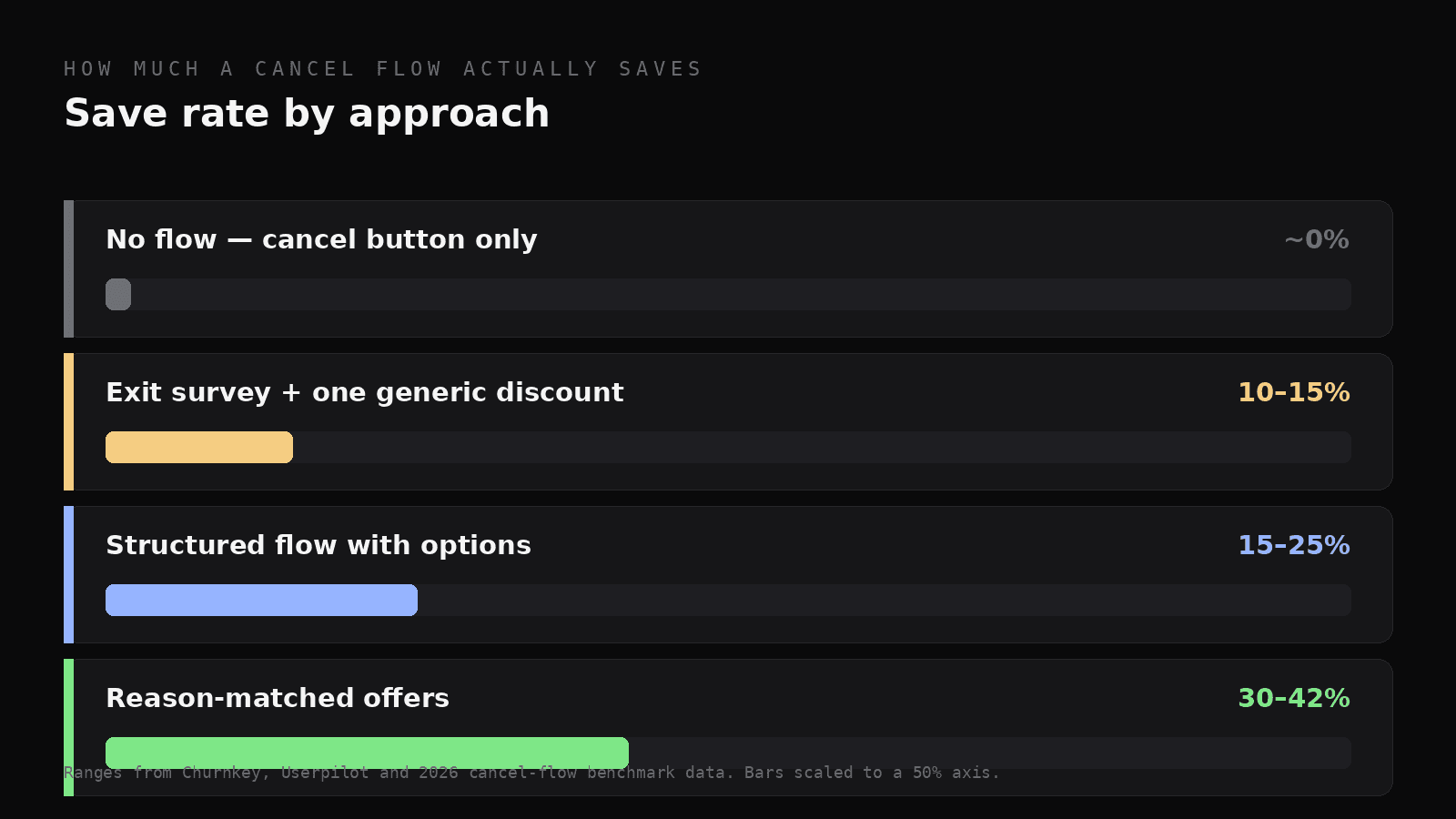
Save rate by approach — the gap between "a discount" and "the right offer" is the whole game.
The benchmarks are consistent across sources. Companies with structured cancellation flows retain 15–25% of customers who start cancelling, against approximately zero when cancellations process straight through. Well-designed flows land in the 10–34% range, with Churnkey's benchmark at 34% across its customer base. And the top performers — the ones matching offers to reasons — reach 30–42%, compared with 10–15% for a basic exit survey plus a single discount.
Sit with that gap for a second. Same traffic, same moment, same product. The difference between a lazy flow and a thoughtful one is roughly tripling the revenue you keep.
The discount trap
Discounts are the default because they're the easiest thing to build and they show an immediate win. The costs arrive later, and they're structural.
You teach a behaviour. If a discount is the reliable outcome of clicking cancel, some proportion of your customers will learn to click cancel. You've created a recurring, self-inflicted price negotiation with your most price-sensitive segment — and they'll be back next renewal.
You anchor the price down permanently. A "temporary" 40% discount rarely feels temporary to the person receiving it. When it lapses, the return to full price reads as a price increase, and you get to have the same cancellation conversation again with a customer who now feels aggrieved.
You mask the actual problem. This is the worst one. Someone cancelling because they never onboarded properly, or because a critical feature is missing, isn't leaving over price. A discount buys you a month of their silence and denies you the signal. You end up with cheaper customers and an unfixed product.
Discounts have a legitimate place — just a narrow one. When the reason genuinely is price, a time-boxed discount or an annual-plan switch is an honest answer. When it isn't, money is the wrong instrument entirely.
Ask why first, then offer
The single structural change that separates a 12% flow from a 35% flow is order. Ask for the reason before presenting any offer, then branch on the answer.
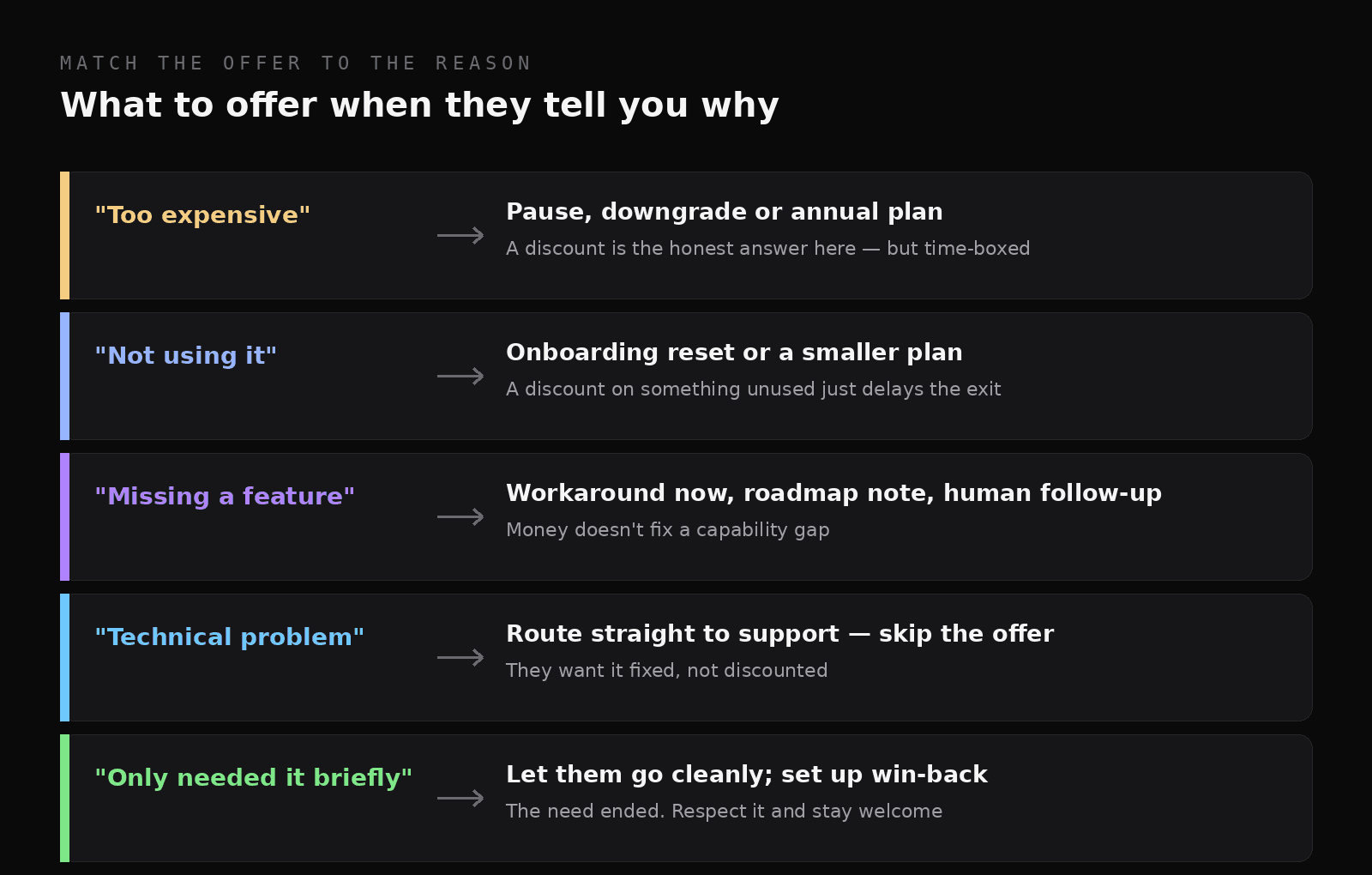
Match the offer to the reason — the difference between a 10–15% flow and a 30–42% one.
Personalised, reason-matched offers reduce voluntary churn by 20–40%, and the logic is obvious once you write it down:
- "Too expensive" → a pause, a downgrade, or an annual plan. This is the one case where a discount is honest — keep it time-boxed.
- "I'm not using it" → an onboarding reset, a walkthrough, or a smaller plan. Discounting an unused product just delays the same exit by a month.
- "Missing a feature" → a workaround if one exists, a roadmap note if it's coming, and a human follow-up if it matters. Money doesn't fill a capability gap.
- "Something's broken" → route straight to support and skip the offer entirely. They want it fixed, not discounted; a discount here reads as a bribe to tolerate a bug.
- "I only needed it for a project" → let them go cleanly and set up a win-back for later. The need genuinely ended.
Keep the reason list short — five or six options plus a free-text box. Long surveys at the exit get abandoned, and an abandoned survey is a lost cancellation and lost feedback.
Pause is the most underrated option
If you only add one thing to your cancel flow, add pause.
The data is remarkable: customers offered a pause instead of immediate cancellation show a 60-day retention rate of 58%, against 11% for those who simply cancel. Roughly a quarter of would-be churners take a pause when it's offered, and pause alone saves 15–20% of cancellations.
It works because it matches how people actually churn. A lot of cancellation isn't rejection — it's timing. A quiet season, a tight month, a project that ended, a holiday. "I don't need this right now" is a completely different statement from "this isn't for me," and a binary cancel button flattens the two into the same irreversible outcome.
Pause also preserves the thing that makes returning easy: their data, their settings, their history, their place in the community. Coming back is a click rather than a decision.
Where the line is
There's a real ethical boundary here, and it's also a commercial one. Good retention helps customers get value they already wanted. Bad retention makes leaving difficult.
Concretely: the cancel path must stay findable and completable. No hiding it three menus deep, no "call us to cancel," no dark-pattern button contrast where "Keep my subscription" is a big green button and "Cancel" is grey four-point text. Beyond being hostile, several jurisdictions have been tightening rules on exactly this — click-to-cancel expectations are becoming the norm, not a courtesy.
The business case is just as strong. Someone you trapped for one extra month is someone who will never refer you, never come back, and may well tell people why. Retention bought with friction is borrowed against goodwill you'll need later — which is why our Revenue Suite treats a clean cancel path, quiet hours and frequency caps as product law rather than settings.
One offer, not three. If they decline the pause, don't counter with a discount, then a smaller plan, then a plea. One relevant offer, then respect the answer.
Measure saves honestly
The same discipline we argued for with failed payments applies here: it's easy to produce an impressive save number and easier still for it to be fiction.
Attribute conservatively. A save is someone who actively chose to stay after seeing an offer — not someone who abandoned the flow halfway and happened to renew, and not someone who "saved" this month and cancelled the next. Track saves that survive 60 and 90 days, not just the moment of the click, because a save that churns in three weeks was a deferral, not a rescue.
And track the reasons as a first-class output. The monthly distribution of cancellation reasons is one of the highest-signal reports in your business — it's your product roadmap, sorted by revenue lost. If "missing feature X" is a third of your cancellations, that's not a retention problem to solve at the exit; it's a product problem you now have data for.
Building one that works
A minimum viable cancel flow, in order:
- A findable cancel button that genuinely cancels. Start from respect.
- One short reason question — five or six options plus free text. Reason first, always.
- One matched offer based on that answer, with pause available for most paths.
- A clean exit when the answer is "let me go" — confirm what happens to their data and access, and say something human.
- A win-back trigger logged for later, so a customer whose need returns can find their way back.
- Reason and save reporting, reviewed monthly, feeding the roadmap.
That's a few days of work for a flow that plausibly triples the leavers you keep — and, more importantly, tells you why the rest are going.
The takeaways
- Instant cancellation saves nobody; a structured flow saves 15–25%; reason-matched offers reach 30–42%.
- A generic discount manages 10–15% and teaches customers to threaten cancellation for a better price.
- Ask why before offering anything, then match the offer to the answer.
- Pause is the most underrated option: 58% 60-day retention vs 11% for straight cancellation.
- Keep the exit clean and countable — measure saves at 60–90 days, and treat cancellation reasons as a revenue-sorted roadmap.
Running a Whop community and want cancel-save handled properly? See the York Revenue Suite or get in touch.
References
- ChurnWard. SaaS Cancellation Flow & Exit Survey Guide — structured-flow retention rates.
- Userpilot (2026). Cancellation Flow Examples: what they recover and what they miss — pause retention data and reason-matched offer performance.
- SaveMRR. SaaS Cancel Flow Best Practices — Churnkey benchmark.
- Lago. SaaS Cancellation Flows: Reduce Churn at the Exit Point.